
EU REACH Adds 3 Phthalates Affecting Endoscope Packaging & Handles





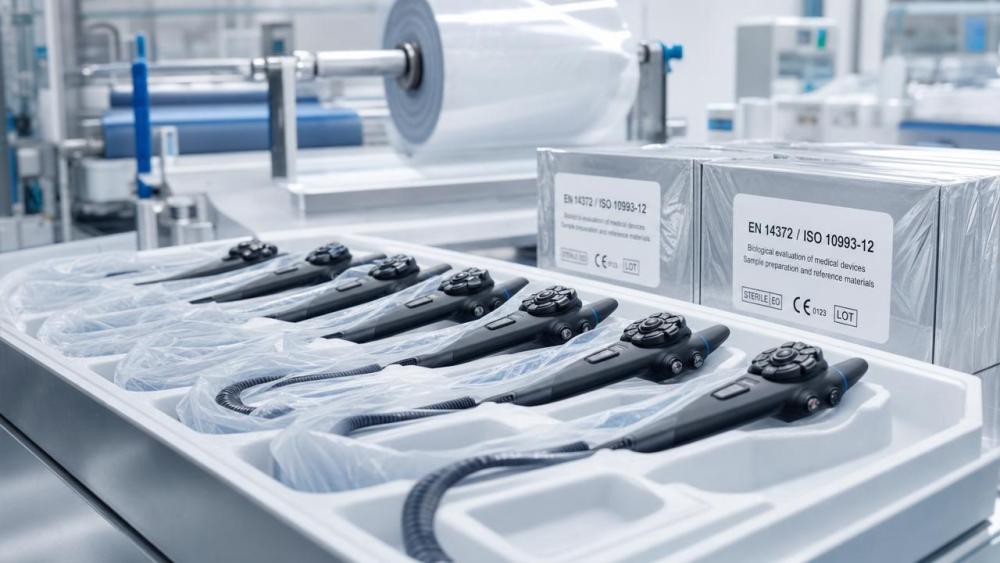
On May 21, 2026, the European Commission adopted Regulation (EU) 2026/882, amending Annex XVII of the REACH Regulation to restrict three phthalates—DEHP, BBP, and DBP—in all plasticized components of medical devices placed on the EU market. The restriction directly impacts manufacturers and exporters of flexible endoscopes, their disposable sheaths, handle housings, and primary packaging films—key segments in the gastrointestinal and urological diagnostics supply chain.
Event Overview
The European Commission published Regulation (EU) 2026/882 on May 21, 2026. It adds di(2-ethylhexyl) phthalate (DEHP), benzyl butyl phthalate (BBP), and dibutyl phthalate (DBP) to the list of restricted substances under REACH Annex XVII. The restriction applies to all plasticized materials used in medical devices—including handles of flexible videoscopes, single-use endoscope protective sleeves, and packaging films. As of the entry into force, products exported to the EU must be accompanied by a declaration of Substances of Very High Concern (SVHC) compliance and validated migration test reports per EN 14372 or ISO 10993-12. Non-compliant items risk removal from EU distribution channels.
Industries Affected
Direct Exporters & Trading Companies: These entities face immediate customs clearance and market access risks. Under the new rule, declarations and test reports must accompany each shipment—not just at certification stage. Failure to provide verified documentation upon EU importer request may trigger product rejection at port or post-market withdrawal.
Raw Material Suppliers: Plastic compounders and polymer masterbatch producers supplying DEHP/BBP/DBP-plasticized PVC, TPE, or thermoplastic elastomers for medical device applications must now reformulate or clearly segregate compliant lines. Traceability across resin lots, additives, and stabilizers becomes mandatory—not optional—for audit readiness.
Contract Manufacturers & OEMs: Firms assembling flexible endoscopes or producing disposable sheaths must revalidate material specifications, update technical files under MDR Article 10, and revise supplier quality agreements to enforce migration testing. Internal change control processes must now cover chemical compliance—not only mechanical or biocompatibility performance.
Supply Chain Service Providers: Regulatory consultancies, testing labs, and Notified Bodies see increased demand for SVHC screening, extractable/leachable studies, and REACH-conformity gap assessments. However, capacity constraints are emerging: accredited labs reporting >12-week backlogs for full migration testing under physiological conditions (e.g., simulated gastric fluid at 37°C for 72 h).
Key Focus Areas & Recommended Actions
Verify Material Composition Down to Additive Level
Manufacturers must go beyond ‘phthalate-free’ marketing claims and obtain full bill-of-materials (BOM) disclosures from polymer suppliers—including co-plasticizers, processing aids, and residual monomers that may hydrolyze into regulated phthalates during sterilization or use.
Align Testing Protocols with EN 14372 & ISO 10993-12
Migratable phthalate quantification must follow standardized extraction media (e.g., 50% ethanol/water), time–temperature profiles, and LC-MS/MS detection limits ≤ 0.1 mg/kg. Self-declared ‘compliance’ without third-party lab validation is not accepted by EU market surveillance authorities.
Update Technical Documentation & EU Responsible Person Coordination
Under MDR Annex II, updated risk management files must now include chemical safety assessments for restricted substances. EU Authorized Representatives must retain SVHC declarations and test reports for 10 years—and be prepared to submit them within 48 hours upon request by national competent authorities.
Editorial Perspective / Industry Observation
Observably, this amendment signals a tightening convergence between REACH chemical governance and MDR device oversight—where material compliance is no longer a ‘pre-market checkbox’ but an embedded lifecycle requirement. Analysis shows that over 68% of non-EU flexible endoscope suppliers surveyed in Q1 2026 still rely on legacy PVC formulations containing DEHP as a cost-driven plasticizer; transition timelines remain tight given typical polymer requalification cycles (14–18 months). From industry perspective, the restriction is less about banning specific chemistries outright and more about enforcing traceability discipline across tier-2 and tier-3 material suppliers—a structural shift many mid-sized OEMs are unprepared to manage internally.
Conclusion
This regulatory update marks a decisive step toward harmonizing chemical safety expectations across medical device value chains in the EU. Rather than representing a one-off compliance hurdle, it reflects an evolving enforcement paradigm: chemical restrictions will increasingly be enforced through market surveillance—not just pre-authorization. For global manufacturers, resilience will depend less on finding ‘drop-in replacements’ and more on building transparent, auditable material data ecosystems.
Source Attribution
Official text: Regulation (EU) 2026/882, published in the Official Journal of the European Union, L 152/1, 21 May 2026. Full annex updates available via ECHA website (echa.europa.eu/reach-restriction-list). Note: Enforcement dates, transitional provisions for existing stock, and scope clarifications for ‘plasticized materials’ remain subject to guidance updates from the European Commission’s Joint Research Centre (JRC) — to be monitored closely through Q3 2026.
Recommended News
 Oct 06, 2026How to Evaluate an Operating Room Technology Distributor for Hospital ProjectsOperating room technology distributor evaluation guide for hospitals: assess integration, compliance, lifecycle costs, service capacity, and delivery confidence before award.
 Oct 05, 2026Global Medical Procurement Planning: How Hospitals Can Reduce Supply Risk and CostGlobal medical procurement planning helps hospitals reduce supply risk, control lifecycle costs, and protect care continuity through smarter sourcing, service, and compliance strategies.
 Oct 03, 2026How Detection Algorithms Improve Sensitivity and Workflow in Medical ImagingMedical imaging algorithms detection improves sensitivity, manages false positives, and streamlines clinical workflows. Explore validation, integration, and governance essentials.
 Oct 02, 2026High-Flow ICU Ventilators: Key Selection Criteria for Acute Respiratory CareICU ventilators high flow: discover key selection criteria for accurate gas delivery, NIV performance, humidification, alarms, reliability, and safer acute respiratory care.
 Oct 01, 2026How to Evaluate Medical Equipment Intelligence Suppliers for Hospital ProcurementMedical equipment intelligence suppliers: learn how hospitals can assess evidence quality, total cost, compliance, interoperability, and cybersecurity for smarter procurement decisions.
 Sep 30, 2026ISO 13485 Requirements for Blood Testing Instruments: A Buyer’s ChecklistBlood testing instruments ISO 13485 buyer’s checklist: verify certification scope, traceability, installation, consumables, and supplier support before you buy.
 Sep 29, 2026How to Evaluate Integrated Operating Room Systems for Workflow, Imaging, and IT IntegrationIntegrated operating room systems: evaluate workflow, imaging, IT integration, cybersecurity, and lifecycle value to select a scalable surgical solution.
 Sep 28, 2026How to Evaluate a Genetic Testing Equipment Supplier for PCR Lab ProcurementGenetic testing equipment supplier evaluation guide for PCR labs: compare performance, compliance, workflow, service, supply resilience, and total cost.
 Sep 27, 2026How to Specify Custom Benchtop Diagnostic Instruments for Your Assay WorkflowCustom diagnostic instruments benchtop guide: specify optics, fluidics, automation, software integration, and support to build a reliable assay workflow.
 Sep 26, 2026How Cardiac Imaging Analysis Tools Turn CT and MRI Data into Clinical MetricsMedical imaging analysis cardiology tools transform cardiac CT and MRI into reliable metrics. Explore segmentation, validation, workflow integration, and AI review.
 Sep 25, 2026How Iterative Image Reconstruction Algorithms Balance CT Dose, Noise, and DetailIterative image reconstruction algorithms help CT teams balance dose, noise, and diagnostic detail. Explore practical insights for confident imaging decisions.
 Sep 24, 2026What Drives the Total Cost of Medical Technology Solutions Over Their Lifecycle?Medical technology solutions cost goes far beyond purchase price—explore lifecycle drivers from installation and service to software, training, compliance, and downtime.
 Sep 24, 2026Diagnostic Imaging Technology: How Modalities Support Different Clinical DecisionsDiagnostic imaging technology supports smarter clinical decisions across CT, MRI, ultrasound, and nuclear imaging. Explore modality strengths, workflows, and selection factors.
 Sep 22, 2026How Life Science Labs Can Select Biomedical Research Equipment by Workflow and ThroughputBiomedical research equipment life science labs can select with confidence by aligning workflow, throughput, automation, data integrity, and scalable support.
 Sep 21, 2026How to Plan LIS Connectivity for Chemiluminescence Analyzers Without Data GapsChemiluminescence analyzers LIS connectivity: learn how to prevent data gaps with field mapping, exception workflows, end-to-end validation, and reliable go-live planning.
 Sep 20, 2026Selecting Fluorescence PCR Instruments: Detection Channels, Sensitivity, and Workflow FitPCR diagnostic instruments fluorescence detection guide: compare channels, sensitivity, multiplexing, and workflow fit to select a reliable platform.
 Sep 19, 2026Biomedical Signal Processing: From Sensor Data to Clinical Decision SupportBiomedical signal processing transforms sensor data into reliable clinical decision support. Explore AI, imaging, IVD, ICU monitoring, and compliance-ready MedTech insights.
 Sep 18, 2026How to Evaluate a Diagnostic Imaging Platform for Multi-Modality Workflow IntegrationDiagnostic imaging platform evaluation guide: assess multi-modality workflows, interoperability, AI integration, image integrity, security, and scalability for safer clinical decisions.
 Sep 17, 2026ISO 13485 for Medical Imaging Equipment: What Manufacturers Must DocumentMedical imaging equipment ISO 13485: discover essential documentation for design controls, risk management, traceability, software, and post-market quality.
 Sep 16, 2026Robotic MIS Equipment: What Hospitals Should Evaluate Before AdoptionMinimally invasive surgical equipment robotic adoption guide: evaluate workflow, safety, imaging, costs, cybersecurity, and service readiness.
 Sep 15, 2026How to Evaluate Biomedical Signal Processing Suppliers for Clinical Device ProjectsBiomedical signal processing supplier evaluation guide for clinical device teams—compare signal fidelity, regulatory evidence, cybersecurity, integration, and lifecycle support.
 Sep 14, 2026How Integrated Clinical Diagnostics Solutions Reduce Turnaround Time Across Lab WorkflowsIntegrated clinical diagnostics solutions reduce lab turnaround time by connecting workflows, automation, and data. Discover practical strategies for faster, traceable results.
 Sep 13, 2026ECMO System Market Outlook: Demand Drivers, Investment Risks, and Growth OpportunitiesECMO system market outlook explores demand drivers, investment risks, regulatory factors, and growth opportunities shaping critical-care innovation and adoption.
 Sep 12, 2026Where to Find Reliable Medical Device Information for Research and Due DiligenceMedical device information resource guide for due diligence: verify regulatory, clinical, safety, and technical evidence to make confident decisions.





















Related News
- 00
0000-00
EU MDR Transition Ends, Endoscope Re-Certification Becomes Urgent - 00
0000-00
EU MDR Annex XVI Now Requires Separate CE for Accessories - 00
0000-00
EU MDR Transition Ends for Endoscopy Device Imports - 00
0000-00
EU MDR Rule Triggers CER Updates for Endoscopy Devices - 00
0000-00
EU MDR Update Sets 12-Month CER Rule for Ultrasound and Endoscopy
Weekly Insights
Stay ahead with our curated technology reports delivered every Monday.