
Hong Kong Opens New Device Registration Path
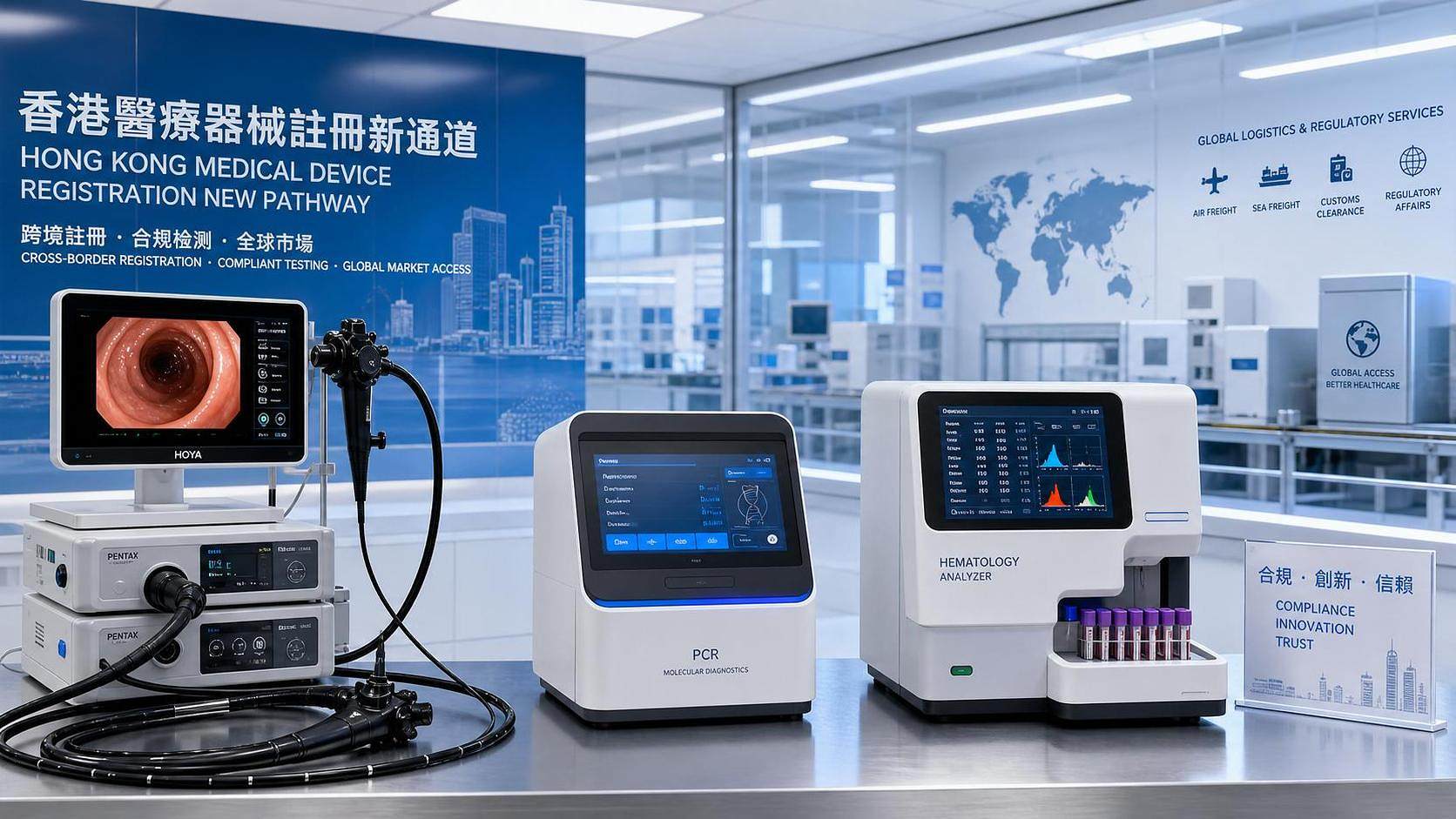




On June 11, 2026, Hong Kong announced a new regulatory move that is directly relevant to medical device registration and cross-border market access: the "Drugs and Medical Devices Regulatory Centre" is set to begin trial operation on July 1, 2026, with first-phase clinical trial filing open for Flexible Videoscopes, Molecular Diagnostics/PCR, and Hematology Analyzers. For mainland companies, the practical significance is not only the ability to run bridging trials in Hong Kong and use local clinical data directly for Hong Kong registration, but also the possibility that the resulting certificate may serve as a market-entry stepping stone for some Southeast Asian and Middle Eastern business plans. This is worth close attention from manufacturers, regulatory teams, distributors, testing partners, and export-facing supply chain operators because it points to a concrete change in how compliance preparation and market sequencing may be arranged.
A New Filing Window Is Being Opened
According to the announced information, the Hong Kong Special Administrative Region's Secretary for Health, Lo Chung-mau, stated on June 11, 2026, that the "Drugs and Medical Devices Regulatory Centre" will start trial operation on July 1, 2026.
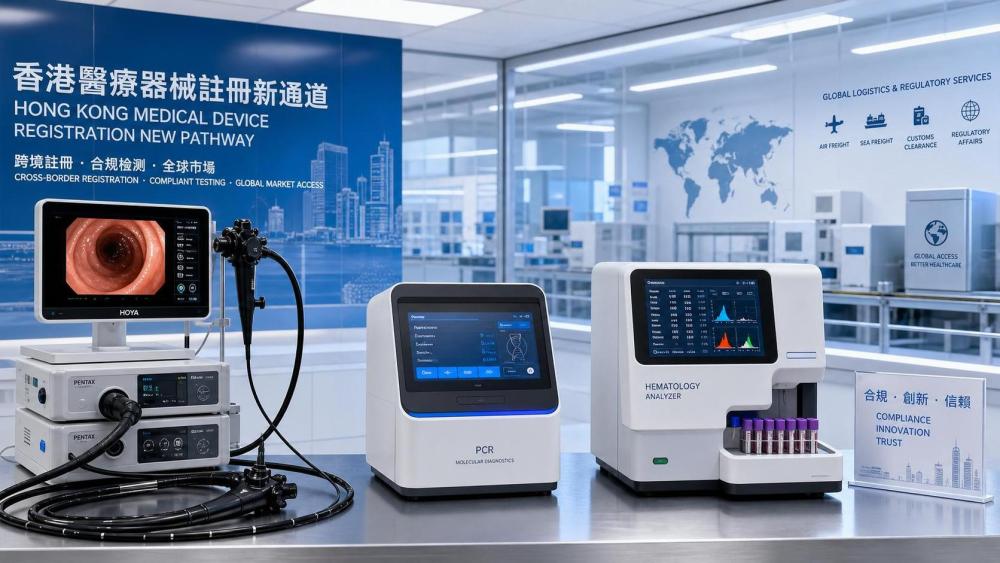
At the first stage, clinical trial filing will be opened for three product categories: Flexible Videoscopes, Molecular Diagnostics/PCR, and Hematology Analyzers.
The announced arrangement also states that mainland enterprises may conduct bridging trials in Hong Kong, and the resulting local clinical data may be used directly for Hong Kong registration.
In addition, the summary provided indicates that the certificate may function as a "golden springboard" for market entry in Southeast Asia and the Middle East.
Where the Immediate Business Impact May Appear
Registration planning may shift closer to Hong Kong
From an industry perspective, manufacturers in the three named product categories may be the first to reassess their registration sequence. The reason is straightforward: if bridging trials can be conducted in Hong Kong and the data can be used directly for local registration, the compliance pathway itself becomes a planning variable. The business impact may appear in dossier preparation, trial scheduling, regulatory budgeting, and product launch sequencing. What deserves closer attention is whether companies already preparing submissions will need to reorganize technical documents, clinical materials, and internal approval timelines around the new filing window.
Channel and export teams may treat the certificate as a trade document signal
For distributors, export teams, and market development staff, the key issue is not only registration in Hong Kong itself, but how a Hong Kong certificate may be positioned in wider commercial negotiations. Analysis shows that if companies are considering Southeast Asia or the Middle East, they may begin to evaluate whether Hong Kong registration can support partner discussions, tender positioning, or entry documentation strategy. That does not mean downstream acceptance is automatic; rather, teams should pay attention to how certificates, supporting technical files, and product claims are presented in trade and procurement contexts.
Testing and compliance support services may face new document demands
Testing institutions, regulatory consultants, and documentation service providers may also be affected because the opening of a clinical trial filing route usually changes the document flow around bridging evidence, technical materials, and registration readiness. Observably, the most immediate operational pressure is likely to fall on the consistency of submission documents, test reports, and product descriptions used across trial filing, registration review, and later commercial use. For service providers, the relevant change is less about volume at this stage and more about alignment with the new regulatory route.
Procurement and after-sales teams should watch qualification language
Procurement-side teams and after-sales operators may not be the first actors involved, but they still need to watch how qualification requirements evolve. If Hong Kong registration becomes part of supplier communication or market-entry claims, procurement files, supplier qualification reviews, and product support materials may eventually need to reflect that status accurately. Analysis shows that companies should avoid treating the announced route as a blanket substitute for all other market requirements and instead verify how any certificate is referenced in contracts, tenders, and post-sales traceability records.
What Companies Should Track Now
Focus first on the three listed product categories
The current arrangement is explicitly tied to Flexible Videoscopes, Molecular Diagnostics/PCR, and Hematology Analyzers in the first phase. Companies outside these categories should be careful not to assume immediate applicability. For firms within scope, the practical task is to confirm whether existing product pipelines, registration targets, and trial preparation work can match the first-phase filing conditions once the trial operation starts.
Prepare for closer review of clinical and technical materials
Because the summary points to bridging trials in Hong Kong and direct use of local clinical data for Hong Kong registration, companies should pay close attention to the completeness and consistency of clinical materials, test records, technical files, and submission narratives. Since no detailed execution rules were provided in the input, it is more appropriate to understand this as an area requiring preparation rather than a fully defined checklist.
Watch official wording and execution practice after July 1
What deserves closer attention is how the trial operation is described and implemented after launch. Companies should monitor whether there are further official explanations on filing practice, review expectations, and document handling for the three initial categories. At this stage, the prudent approach is to track the execution language carefully rather than assume that all operational standards have already been settled.
Align export, tender, and compliance messaging
If companies intend to use a Hong Kong certificate in broader overseas market development, internal teams should align how they describe that certificate in export materials, partner communication, tender responses, and compliance statements. Analysis shows that this is especially relevant where sales teams, distributors, and regulatory staff may otherwise use different wording for the same registration status, creating avoidable trade or compliance risk.
Why This Looks Like an Execution Signal, Not a Finished Rule Set
Observably, this development is more meaningful as an execution signal than as a complete and settled regulatory framework. The reason is that the announcement already identifies a start date, a trial-operation mechanism, and three initial product categories, which gives the market a concrete operating reference. At the same time, the input does not provide detailed procedural rules, review standards, or downstream recognition conditions beyond the announced arrangement.
From an industry perspective, that combination matters. It suggests that companies can begin internal planning, but should avoid treating the route as fully mature in practice until more execution details, market feedback, and actual filing experience emerge. The real test will be how consistently the pathway is applied and how market participants interpret the resulting registration outcome in procurement and cross-border business settings.
How This Is Best Understood at This Stage
At this stage, the announcement is best understood as a concrete regulatory opening with direct relevance for selected medical device categories, especially where mainland enterprises are considering Hong Kong registration and broader export sequencing. It points to a possible restructuring of compliance preparation and market-entry planning, but it does not yet justify broad assumptions beyond the facts provided.
A rational reading is that the change has practical value now as a planning and compliance signal, while its full commercial and regulatory effect still depends on subsequent execution details, filing practice, and market response.
Basis of This Article
This article is generated based on the user-provided news title, event date, and event summary. No specific official source link was provided in the input, so the exact official source link remains to be verified on an ongoing basis.
For developments of this kind, commonly relevant source types may include official announcements, releases from regulatory authorities, trade or customs-related notices, industry association updates, standards-related documents, and reporting by authoritative media. Observably, the areas that still require follow-up include detailed implementation rules, certification and registration interpretation in practice, possible changes in tender documents, industry feedback, and how companies actually execute against the announced pathway.
Recommended News
 Oct 02, 2026High-Flow ICU Ventilators: Key Selection Criteria for Acute Respiratory CareICU ventilators high flow: discover key selection criteria for accurate gas delivery, NIV performance, humidification, alarms, reliability, and safer acute respiratory care.
 Oct 01, 2026How to Evaluate Medical Equipment Intelligence Suppliers for Hospital ProcurementMedical equipment intelligence suppliers: learn how hospitals can assess evidence quality, total cost, compliance, interoperability, and cybersecurity for smarter procurement decisions.
 Sep 30, 2026ISO 13485 Requirements for Blood Testing Instruments: A Buyer’s ChecklistBlood testing instruments ISO 13485 buyer’s checklist: verify certification scope, traceability, installation, consumables, and supplier support before you buy.
 Sep 29, 2026How to Evaluate Integrated Operating Room Systems for Workflow, Imaging, and IT IntegrationIntegrated operating room systems: evaluate workflow, imaging, IT integration, cybersecurity, and lifecycle value to select a scalable surgical solution.
 Sep 28, 2026How to Evaluate a Genetic Testing Equipment Supplier for PCR Lab ProcurementGenetic testing equipment supplier evaluation guide for PCR labs: compare performance, compliance, workflow, service, supply resilience, and total cost.
 Sep 27, 2026How to Specify Custom Benchtop Diagnostic Instruments for Your Assay WorkflowCustom diagnostic instruments benchtop guide: specify optics, fluidics, automation, software integration, and support to build a reliable assay workflow.
 Sep 26, 2026How Cardiac Imaging Analysis Tools Turn CT and MRI Data into Clinical MetricsMedical imaging analysis cardiology tools transform cardiac CT and MRI into reliable metrics. Explore segmentation, validation, workflow integration, and AI review.
 Sep 25, 2026How Iterative Image Reconstruction Algorithms Balance CT Dose, Noise, and DetailIterative image reconstruction algorithms help CT teams balance dose, noise, and diagnostic detail. Explore practical insights for confident imaging decisions.
 Sep 24, 2026What Drives the Total Cost of Medical Technology Solutions Over Their Lifecycle?Medical technology solutions cost goes far beyond purchase price—explore lifecycle drivers from installation and service to software, training, compliance, and downtime.
 Sep 24, 2026Diagnostic Imaging Technology: How Modalities Support Different Clinical DecisionsDiagnostic imaging technology supports smarter clinical decisions across CT, MRI, ultrasound, and nuclear imaging. Explore modality strengths, workflows, and selection factors.
 Sep 22, 2026How Life Science Labs Can Select Biomedical Research Equipment by Workflow and ThroughputBiomedical research equipment life science labs can select with confidence by aligning workflow, throughput, automation, data integrity, and scalable support.
 Sep 21, 2026How to Plan LIS Connectivity for Chemiluminescence Analyzers Without Data GapsChemiluminescence analyzers LIS connectivity: learn how to prevent data gaps with field mapping, exception workflows, end-to-end validation, and reliable go-live planning.
 Sep 20, 2026Selecting Fluorescence PCR Instruments: Detection Channels, Sensitivity, and Workflow FitPCR diagnostic instruments fluorescence detection guide: compare channels, sensitivity, multiplexing, and workflow fit to select a reliable platform.
 Sep 19, 2026Biomedical Signal Processing: From Sensor Data to Clinical Decision SupportBiomedical signal processing transforms sensor data into reliable clinical decision support. Explore AI, imaging, IVD, ICU monitoring, and compliance-ready MedTech insights.
 Sep 18, 2026How to Evaluate a Diagnostic Imaging Platform for Multi-Modality Workflow IntegrationDiagnostic imaging platform evaluation guide: assess multi-modality workflows, interoperability, AI integration, image integrity, security, and scalability for safer clinical decisions.
 Sep 17, 2026ISO 13485 for Medical Imaging Equipment: What Manufacturers Must DocumentMedical imaging equipment ISO 13485: discover essential documentation for design controls, risk management, traceability, software, and post-market quality.
 Sep 16, 2026Robotic MIS Equipment: What Hospitals Should Evaluate Before AdoptionMinimally invasive surgical equipment robotic adoption guide: evaluate workflow, safety, imaging, costs, cybersecurity, and service readiness.
 Sep 15, 2026How to Evaluate Biomedical Signal Processing Suppliers for Clinical Device ProjectsBiomedical signal processing supplier evaluation guide for clinical device teams—compare signal fidelity, regulatory evidence, cybersecurity, integration, and lifecycle support.
 Sep 14, 2026How Integrated Clinical Diagnostics Solutions Reduce Turnaround Time Across Lab WorkflowsIntegrated clinical diagnostics solutions reduce lab turnaround time by connecting workflows, automation, and data. Discover practical strategies for faster, traceable results.
 Sep 13, 2026ECMO System Market Outlook: Demand Drivers, Investment Risks, and Growth OpportunitiesECMO system market outlook explores demand drivers, investment risks, regulatory factors, and growth opportunities shaping critical-care innovation and adoption.
 Sep 12, 2026Where to Find Reliable Medical Device Information for Research and Due DiligenceMedical device information resource guide for due diligence: verify regulatory, clinical, safety, and technical evidence to make confident decisions.
 Sep 11, 2026Medical Equipment Intelligence: A Resource for Comparing Clinical TechnologiesMedical equipment intelligence resource for comparing clinical technologies by clinical fit, compliance, workflow, and total cost—make confident, evidence-led decisions.
 Sep 10, 2026How to Integrate Application-Specific Medical Solutions Into Existing Clinical WorkflowsApplication-specific medical solutions integration: learn how to align clinical workflows, interoperability, safety, and measurable outcomes for reliable deployment.
 Sep 09, 2026Medical Supplier Evaluation Checklist: How to Verify Quality, Compliance, and Delivery RiskMedical supplier evaluation checklist for verifying quality, compliance, service capacity, configuration accuracy, and delivery risk before purchase approval.

















Related News
- 00
0000-00
EU MDR Transition Ends, Endoscope Re-Certification Becomes Urgent - 00
0000-00
EU MDR Annex XVI Now Requires Separate CE for Accessories - 00
0000-00
EU MDR Transition Ends for Endoscopy Device Imports - 00
0000-00
EU MDR Rule Triggers CER Updates for Endoscopy Devices - 00
0000-00
EU MDR Update Sets 12-Month CER Rule for Ultrasound and Endoscopy
Weekly Insights
Stay ahead with our curated technology reports delivered every Monday.