
EU MDR Annex XVI Expands Rigid Endoscope Rules
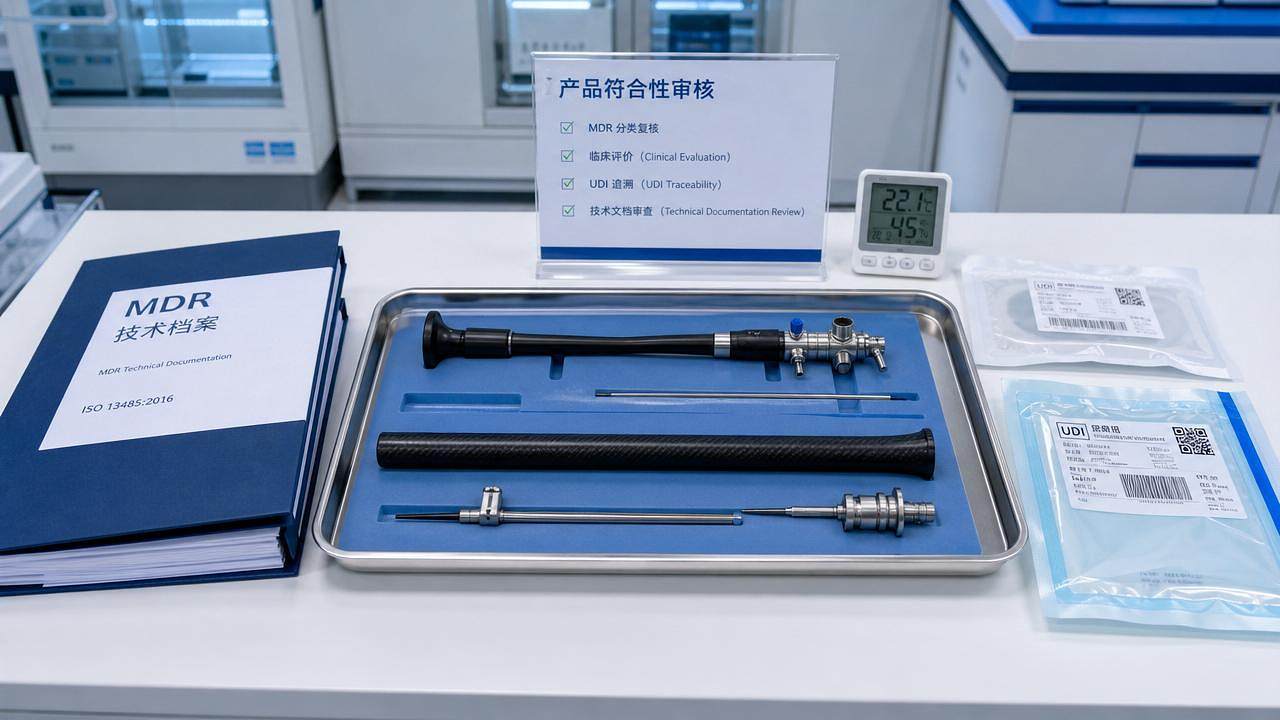




Image Placement Plan
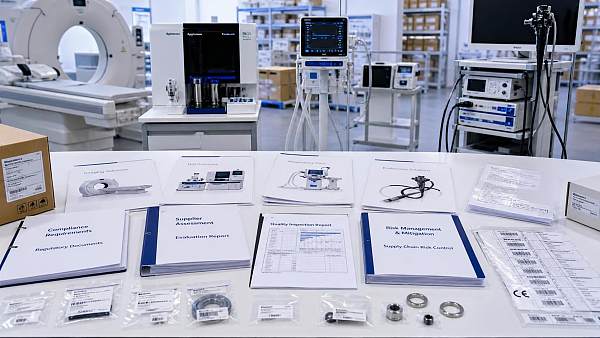
Place the single image near the opening section to illustrate regulatory compliance review for rigid endoscopy systems, implant-guidance components, and UDI traceability documentation.
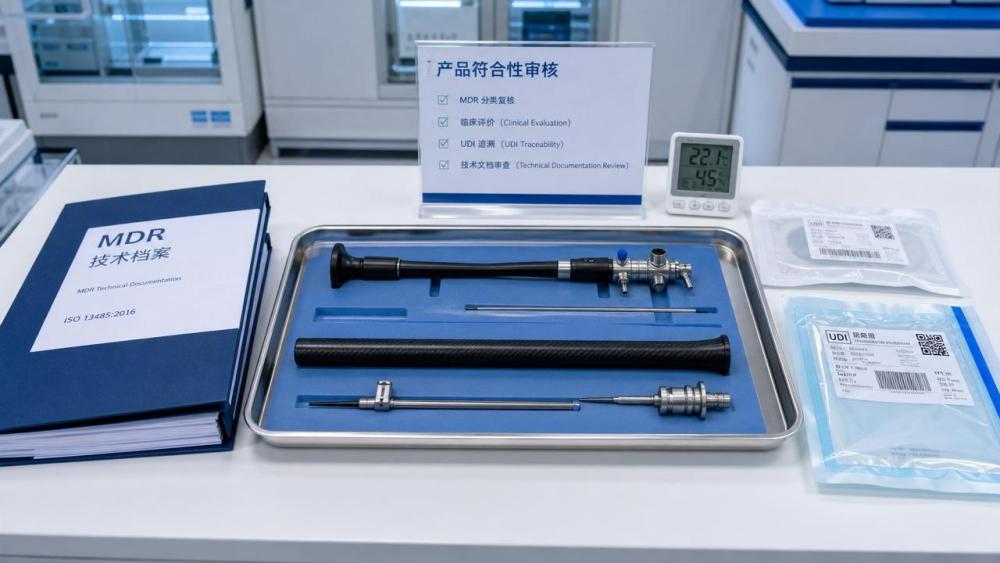
On June 2, 2026, the European Commission released MDR amendment EU 2026/987, expanding Annex XVI coverage for certain rigid endoscopy system components used in permanent implant guidance. The change affects rigid endoscope-related medical device exports to the European market because classification review, clinical evaluation, UDI traceability, and technical documentation requirements may need immediate reassessment by Chinese manufacturers.
Confirmed Regulatory Update
The confirmed event is the European Commission's release of MDR amendment EU 2026/987 on June 2, 2026.
According to the provided event summary, the amendment brings certain components within Rigid Endoscopy Systems into the Annex XVI category of passive implantable devices when they are used for permanent implant guidance in joint cavities, the spinal canal, and laparoscopic procedures.
The affected examples include carbon-fiber guiding sheaths and titanium alloy trocar cannulas. The amendment makes these components subject to more stringent clinical evaluation and UDI traceability requirements.
The provided information also states that the adjustment immediately affects classification determination and technical documentation upgrades for Chinese manufacturers exporting to Europe.
How the Rule Change May Affect Market Participants
Direct exporters and trading companies
From an industry perspective, direct exporters may be affected because the amended scope can change how rigid endoscopy system components are classified before shipment to the European market. The impact is most likely to appear in product classification checks, export documentation, customer declarations, and communication with European buyers.
Companies in this role should pay close attention to whether products used for permanent implant guidance fall within the newly covered use scenarios, especially where product descriptions mention joint cavities, the spinal canal, or laparoscopic implant guidance.
Raw material procurement teams
Analysis shows that procurement functions may face higher pressure to support traceability and material verification. The examples identified in the update include carbon-fiber guiding sheaths and titanium alloy trocar cannulas, which means material-related records may become more important in the technical file and UDI traceability chain.
Procurement teams may need to review supplier documentation, material identification records, and batch-level traceability information to ensure that upstream evidence can support downstream compliance review.
Processing and manufacturing companies
Manufacturers may be affected because stricter clinical evaluation and UDI traceability requirements can require updates to product classification logic, design records, manufacturing documentation, inspection evidence, and technical files. The issue is not limited to finished devices; components intended for implant-guidance use may also require closer compliance review.
What deserves closer attention is the link between intended use and regulatory classification. If a rigid endoscope component is used to guide permanent implantation, the company may need to reassess whether existing documentation remains adequate under the amended Annex XVI coverage.
Supply chain service providers
Supply chain service providers, including logistics coordinators, documentation service providers, and compliance support partners, may be affected through document verification and traceability requirements. Their operational role may involve checking whether shipment records, product identifiers, and supporting technical documents remain consistent with the updated classification.
It is more appropriate to understand this as a compliance-chain issue rather than a purely logistics-related adjustment. Service providers may need to coordinate earlier with manufacturers and exporters to avoid mismatches between product use, regulatory classification, and shipment documentation.
Key Compliance Actions for Companies
Recheck intended use before classification
Companies should first review whether their rigid endoscopy system components are used for permanent implant guidance in joint cavities, the spinal canal, or laparoscopic procedures. This intended-use assessment is central to determining whether the amended Annex XVI coverage applies.
Upgrade clinical evaluation evidence where applicable
Because the update applies more stringent clinical evaluation requirements to the covered category, manufacturers should examine whether existing clinical evaluation files are sufficient for the newly affected components. Any gap should be addressed through documented review rather than informal product judgment.
Strengthen UDI traceability across components
The amendment highlights UDI traceability. Companies should check whether product identifiers, batch records, material records, technical files, and export documents are aligned. This is especially relevant where components such as carbon-fiber guiding sheaths or titanium alloy trocar cannulas are supplied as part of a broader rigid endoscopy system.
Align technical files with European export requirements
Chinese manufacturers exporting to Europe should review whether technical documentation reflects the updated classification basis. Documentation updates may need to cover intended use, component descriptions, material information, UDI records, and clinical evaluation references connected to the affected implant-guidance applications.
Industry Observation: Compliance Pressure Moves Upstream
Analysis shows that the amendment may shift compliance attention from finished system approval alone toward component-level intended use and traceability. For rigid endoscopy system suppliers, this may increase the importance of early classification review during product planning and order confirmation.
From an industry perspective, the change may also raise practical barriers for companies whose documentation systems are not closely connected across design, procurement, production, quality control, and export operations. The regulatory issue is likely to be less about a single certificate and more about whether the full evidence chain can support the product's claimed use.
Observably, buyers and distributors may become more cautious when reviewing products associated with implant guidance. However, the specific execution approach will still depend on further regulatory interpretation, certification practice, and buyer-side document requirements.
Measured Outlook
The expansion of MDR Annex XVI coverage for certain rigid endoscopy system components marks a significant compliance signal for manufacturers, exporters, and supply chain partners serving the European market. Its immediate importance lies in classification determination, clinical evaluation readiness, UDI traceability, and technical documentation consistency.
A rational conclusion is that companies should not overstate the impact before implementation details become clearer, but they should begin structured internal review where affected products are used for permanent implant guidance.
Information Basis and Items to Monitor
This article is generated based on the provided news title, event date, and event summary. Specific official source links were not provided in the input and should be verified continuously.
For events of this type, relevant authoritative source types may include official EU legislative publications, MDR implementation materials, notified body guidance, and regulatory communications from competent authorities.
Items requiring continued monitoring include detailed implementation rules, certification interpretation, notified body review practice, tender and specification changes, buyer documentation requirements, and industry feedback on technical file updates.
Recommended News
 Sep 01, 2026What to Evaluate in AI Image Reconstruction Software for Clinical Imaging?AI image reconstruction software: learn how to evaluate diagnostic fidelity, workflow integration, safety, and change control for confident clinical imaging decisions.
 Aug 31, 2026Clinical Imaging Innovation: Which Technologies Deliver Measurable Diagnostic Gains?Clinical imaging innovation delivers measurable diagnostic gains through photon-counting CT, AI reconstruction, and quantitative MRI—explore evidence-based selection insights.
 Aug 30, 2026How Surgical Navigation Technology Improves Accuracy in Complex Spine SurgerySurgical navigation technology spine surgery: discover how imaging, tracking, and workflow controls improve precision for complex procedures.
 Aug 29, 2026How to Select a Hematology Analyzer With Reliable Reticulocyte CountingHematology analyzers retic selection guide: compare precision, flags, workflow, QC, and connectivity to achieve reliable reticulocyte counting.
 Aug 28, 2026Planning Operating Room Technology for a High-Throughput Surgery CenterOperating room technology for a surgery center: plan workflows, integration, uptime, and safety to boost throughput and create future-ready surgical rooms.
 Aug 27, 2026Building Medical Compliance Analytics for Middle East Market AccessMedical compliance analytics Middle East: build device-specific evidence maps, align local requirements, and accelerate market access with confidence.
 Aug 26, 2026How Surgical Equipment Digitalization Is Reshaping Hospital Investment in Latin AmericaSurgical equipment digitalization Latin America is reshaping hospital investment, from smart ORs to ROI-driven upgrades. Explore what buyers now value most.
 Aug 25, 2026How to Evaluate a Medical Compliance Intelligence Provider for Global Market AccessMedical compliance intelligence provider selection can make or break global market access. Learn how to assess technical depth, update quality, and commercial fit before choosing.
 Aug 24, 2026How Advanced Clinical Imaging Is Improving Cardiology Diagnosis and Treatment PlanningAdvanced clinical imaging cardiology is transforming diagnosis and treatment planning with clearer anatomy, tissue insight, and procedural guidance. Discover how it reduces uncertainty and supports smarter cardiac decisions.
 Aug 23, 2026How to Source Medical Devices in North America: Supplier Vetting and Market Access RisksMedical device sourcing North America made practical: learn how to vet suppliers, reduce compliance risks, and protect market access with smarter procurement decisions.
 Aug 22, 2026What Are Integrated Critical Care Systems and How Do Hospitals Evaluate Them?Critical care systems integrated: learn how hospitals assess ICU platforms for interoperability, alarm safety, workflow efficiency, and long-term value before buying.
 Aug 21, 2026How to Evaluate High-Resolution Diagnostic Imaging Systems for Detail-Critical ExamsDiagnostic imaging systems high resolution: learn how to compare detail-critical performance, workflow fit, dose efficiency, and ROI to choose the right system with confidence.
 Aug 20, 2026How to Evaluate Medical Equipment Performance Before Purchase?Medical equipment evaluation performance starts before purchase. Learn how to assess safety, workflow fit, compliance, uptime, and total cost to choose devices that truly perform.
 Aug 19, 2026How to Evaluate Small-Footprint Laboratory Diagnostic Equipment for Space-Limited LabsLaboratory diagnostic equipment small footprint choices require more than size checks. Learn how to assess workflow, throughput, compliance, and service access for smarter lab buying.
 Aug 18, 2026Biochemical Molecular Diagnostics Explained: Methods, Clinical Uses, and Lab Selection CriteriaBiochemical molecular diagnostics explained: compare key methods, clinical applications, and lab selection criteria to choose reliable, compliant testing with confidence.
 Aug 17, 2026How to Choose Diagnostic Equipment Solutions for a Clinic: Key Factors That Affect Workflow and CostDiagnostic equipment solutions clinic buyers can use to improve workflow, control total cost, and avoid hidden service risks. Learn the key factors before you invest.
 Aug 16, 2026How to Choose a Blood Cell Analyzer for a Small Lab: Throughput, CBC Menu, and CostBlood cell analyzers small lab buyers can compare throughput, CBC menu, and total operating cost with confidence. Learn how to avoid waste, reduce downtime, and choose the right fit.
 Aug 16, 2026FDA Approval of AMDS Hybrid Prosthesis Removes IRB Step for Faster U.S. AccessFDA approval of AMDS Hybrid Prosthesis removes the IRB step, speeding U.S. access for acute aortic dissection care and reshaping hospital procurement and supporting equipment demand.
 Aug 15, 2026What Hospital Technology Infrastructure Is Needed for Reliable Interoperability?Hospital technology infrastructure interoperability depends on secure networks, integration engines, identity services, and governance. Discover what hospitals need for reliable, scalable connectivity.
 Aug 14, 2026What to Look for in an Advanced Diagnostic Systems Distributor Before You BuyAdvanced diagnostic systems distributor: learn what to check before buying, from compliance and technical depth to delivery reliability and after-sales support. Make a smarter procurement decision today.
 Aug 14, 2026China Temporarily Bans Helium ExportsChina Temporarily Bans Helium Exports: learn how the July 10, 2026 rule may disrupt MRI, ECMO, and anesthesia device supply chains, compliance, and delivery planning for global buyers.
 Aug 13, 2026How CT Reconstruction Technology Impacts Image Quality, Dose, and WorkflowMedical imaging reconstruction technology CT shapes image quality, dose, and workflow. Learn how smarter CT reconstruction improves diagnostics and efficiency.
 Aug 13, 2026FDA clears AMDS PMA, easing U.S. hospital accessFDA clears AMDS PMA, easing U.S. hospital access for Artivion’s aortic arch device and speeding procurement, compliance, and deployment.
 Aug 12, 2026Hospital Diagnostic Equipment Comparison: What Buyers Should Evaluate Beyond PriceDiagnostic equipment comparison hospital buyers can trust: learn how to evaluate clinical performance, uptime, compliance, integration, and long-term ROI beyond price.



















Related News
- 00
0000-00
FDA clears AMDS PMA, easing U.S. hospital access - 00
0000-00
EU Ends MDD Grace Period for Rigid Endoscopy Systems - 00
0000-00
Endoscopic Imaging Technology 4K vs HD: Which Specs Matter in Daily Clinical Use? - 00
0000-00
EU Extends MDR Class IIa Deadline, Ends Rigid Endoscope Exemption - 00
0000-00
EU MDR Extends Class IIa Transition, Ends Rigid Endoscopy Exemption
Weekly Insights
Stay ahead with our curated technology reports delivered every Monday.