
FDA Tightens PCCP Rule for AI Endoscopy Software
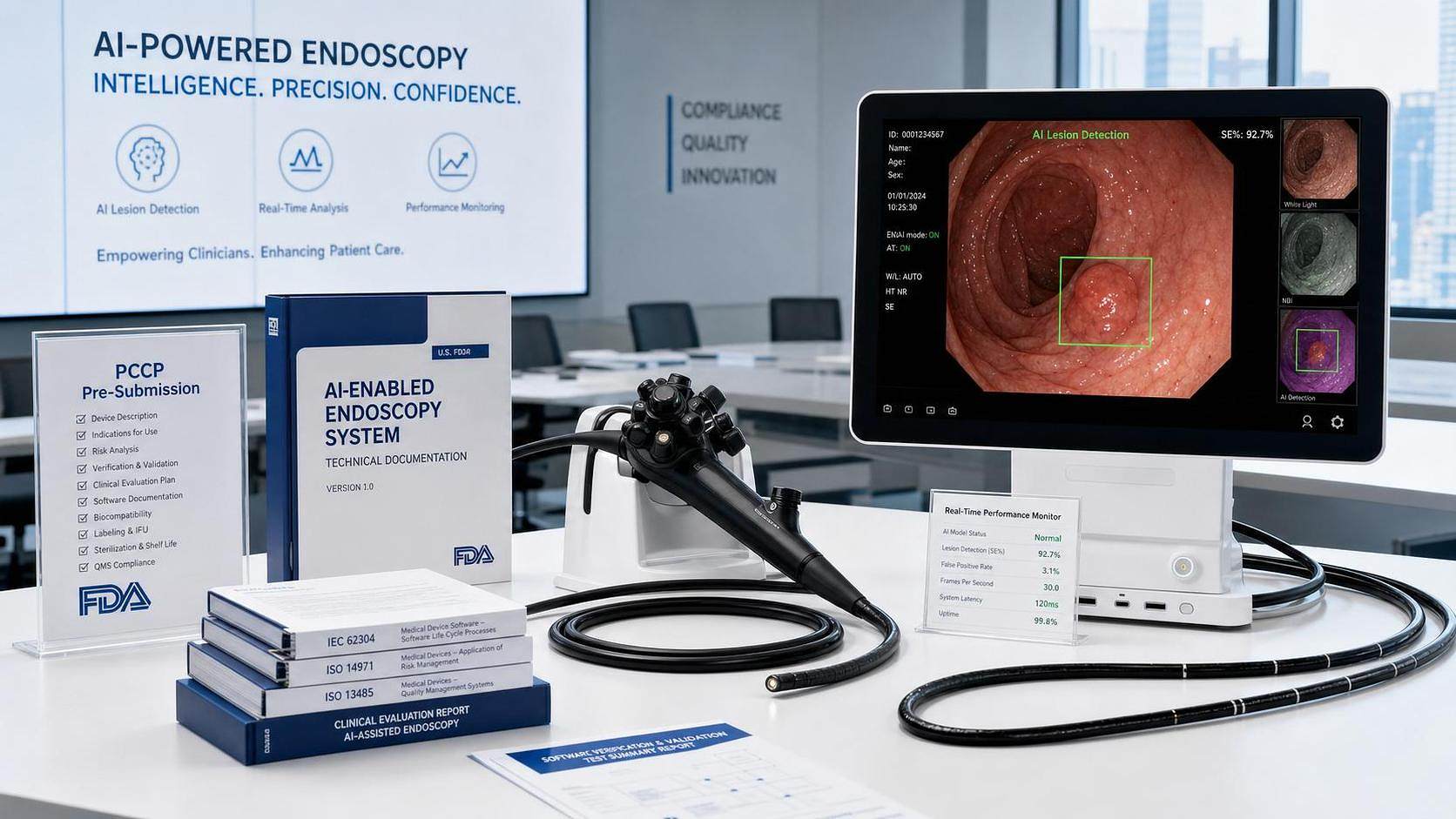




On June 23, 2026, the FDA updated its premarket submission guidance for AI/ML-enabled software used with flexible endoscopy, making pre-submitted Predetermined Change Control Plans (PCCPs) and real-time performance monitoring a clear compliance focus. For manufacturers, exporters, and regulatory teams involved in flexible videoscope imaging enhancement, lesion detection, or navigation software, this development is worth close attention because it may affect U.S. registration pathways, review timing, and compliance costs, particularly for Chinese flexible videoscope companies serving the U.S. market.
What the FDA update explicitly requires
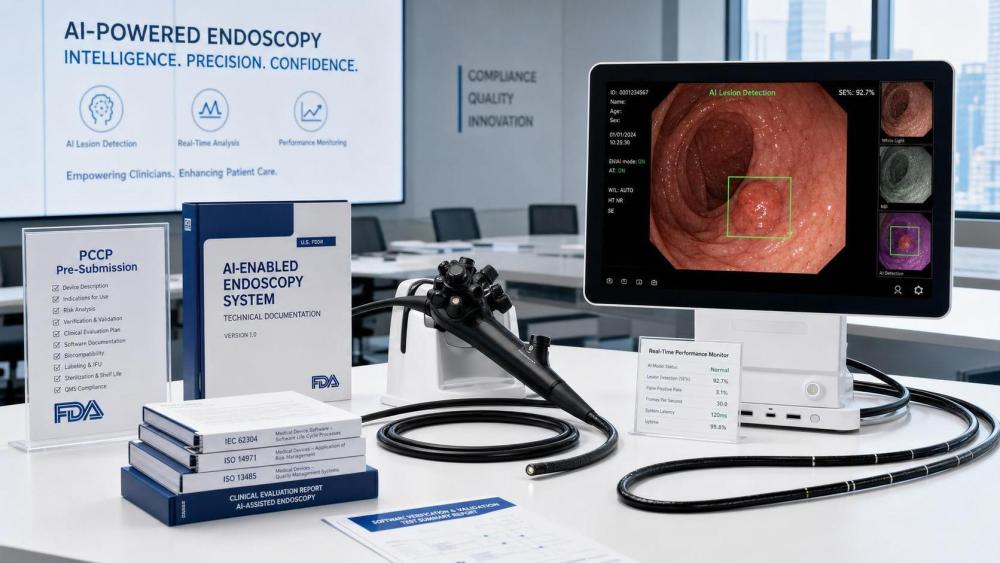
According to the information provided, the FDA released the document titled AI/ML-enabled Flexible Endoscopy Software: Premarket Submission Guidance Update on June 23, 2026. The update states that AI software as a medical device used for image enhancement, lesion identification, or navigation in flexible endoscopy must submit a PCCP before marketing and must establish a real-time performance monitoring mechanism.
The same information also indicates that this policy directly affects the U.S. export registration path, review cycle, and compliance cost structure for Chinese manufacturers of flexible video endoscopy products.
Where the pressure is likely to appear in the industry chain
Export registration teams face a more structured premarket burden
From an industry perspective, companies pursuing U.S. market access may be affected first at the registration stage. Because the update links algorithm change management to premarket submission expectations, regulatory affairs teams will likely need to pay closer attention to how software updates are planned, described, and documented before filing.
Product and software teams may need tighter change coordination
Analysis shows that the impact is not limited to document preparation. For businesses developing AI functions for image enhancement, lesion recognition, or navigation, the rule signals that algorithm changes may need to be managed within a clearer pre-defined control framework, which could influence internal coordination between product, software, quality, and regulatory functions.
Compliance and post-market operations become more visible
What deserves closer attention is the requirement for real-time performance monitoring. For service providers and operational teams supporting AI-enabled endoscopy software, this points to stronger expectations around ongoing performance oversight after market entry, not only at the initial submission stage.
Trade-facing manufacturers may see timing and cost implications
For Chinese flexible videoscope manufacturers exporting to the United States, the provided information already indicates possible effects on review cycles and compliance costs. Observably, this means commercial planning, submission scheduling, and customer communication may all need closer alignment with regulatory preparation.
What companies should watch now
Track how PCCP expectations are applied in practice
Analysis shows that the key issue is not only the existence of a new requirement, but how detailed FDA expectations may be in actual submissions. Companies should closely watch subsequent official wording, interpretive updates, or review practices related to PCCP content for AI endoscopy software.
Review which product functions fall within the stated scope
What deserves closer attention is whether current or planned software functions relate to image enhancement, lesion identification, or navigation in flexible endoscopy. Businesses with products touching these functions may need to reassess filing scope, submission preparation, and internal evidence readiness.
Separate policy signaling from immediate operational impact
Observably, the guidance update is a regulatory signal with direct compliance implications, but the exact business effect may vary by product pipeline and submission status. Companies should avoid treating every software adjustment as identical in impact and instead map the rule to specific products, planned algorithm changes, and market-entry timelines.
Prepare documentation and customer communication earlier
For exporters and market-facing teams, practical attention should go to submission documents, monitoring arrangements, delivery timelines, and communication with U.S. customers or partners. If review timing or compliance cost assumptions change, those changes may need to be reflected earlier in project planning and external commitments.
Why this looks like more than a short-term filing update
Analysis shows that this development is better understood as a policy signal about how AI change management in flexible endoscopy software is expected to be handled, rather than as a routine wording adjustment. The combination of premarket PCCP submission and real-time performance monitoring suggests attention is shifting toward the full lifecycle of AI software governance.
At the same time, it is more appropriate to understand this as an industry development that still requires continued observation rather than a fully settled commercial outcome. The confirmed facts show a clear regulatory direction, but the practical impact on timelines, costs, and market strategies will depend on how companies and reviewers apply the guidance in specific cases.
How to read this update at this stage
At this stage, the FDA update should be read as a concrete compliance change for AI software used in flexible endoscopy and as a longer-term signal for companies relying on algorithm iteration in the U.S. market. The immediate takeaway is not that market access conditions have fully stabilized, but that premarket change planning and post-market performance monitoring now deserve earlier and more structured attention.
A neutral reading is that the policy has already created a clearer expectation for affected products, while the full operational impact still needs to be tracked through subsequent implementation and review practice.
Basis of this article
This article is generated based on the user-provided news title, event date, and event summary. Information of this type is commonly cross-checked against official agency notices, company disclosures, industry association updates, authoritative media coverage, and relevant standards or guidance documents.
No specific official source link was provided in the input, so the underlying document link and any subsequent interpretive materials still require ongoing verification. Further observation should focus on future FDA wording, implementation details for PCCP submissions, and how real-time performance monitoring expectations are reflected in actual regulatory practice.
Recommended News
 Sep 22, 2026How Life Science Labs Can Select Biomedical Research Equipment by Workflow and ThroughputBiomedical research equipment life science labs can select with confidence by aligning workflow, throughput, automation, data integrity, and scalable support.
 Sep 21, 2026How to Plan LIS Connectivity for Chemiluminescence Analyzers Without Data GapsChemiluminescence analyzers LIS connectivity: learn how to prevent data gaps with field mapping, exception workflows, end-to-end validation, and reliable go-live planning.
 Sep 20, 2026Selecting Fluorescence PCR Instruments: Detection Channels, Sensitivity, and Workflow FitPCR diagnostic instruments fluorescence detection guide: compare channels, sensitivity, multiplexing, and workflow fit to select a reliable platform.
 Sep 19, 2026Biomedical Signal Processing: From Sensor Data to Clinical Decision SupportBiomedical signal processing transforms sensor data into reliable clinical decision support. Explore AI, imaging, IVD, ICU monitoring, and compliance-ready MedTech insights.
 Sep 18, 2026How to Evaluate a Diagnostic Imaging Platform for Multi-Modality Workflow IntegrationDiagnostic imaging platform evaluation guide: assess multi-modality workflows, interoperability, AI integration, image integrity, security, and scalability for safer clinical decisions.
 Sep 17, 2026ISO 13485 for Medical Imaging Equipment: What Manufacturers Must DocumentMedical imaging equipment ISO 13485: discover essential documentation for design controls, risk management, traceability, software, and post-market quality.
 Sep 16, 2026Robotic MIS Equipment: What Hospitals Should Evaluate Before AdoptionMinimally invasive surgical equipment robotic adoption guide: evaluate workflow, safety, imaging, costs, cybersecurity, and service readiness.
 Sep 15, 2026How to Evaluate Biomedical Signal Processing Suppliers for Clinical Device ProjectsBiomedical signal processing supplier evaluation guide for clinical device teams—compare signal fidelity, regulatory evidence, cybersecurity, integration, and lifecycle support.
 Sep 14, 2026How Integrated Clinical Diagnostics Solutions Reduce Turnaround Time Across Lab WorkflowsIntegrated clinical diagnostics solutions reduce lab turnaround time by connecting workflows, automation, and data. Discover practical strategies for faster, traceable results.
 Sep 13, 2026ECMO System Market Outlook: Demand Drivers, Investment Risks, and Growth OpportunitiesECMO system market outlook explores demand drivers, investment risks, regulatory factors, and growth opportunities shaping critical-care innovation and adoption.
 Sep 12, 2026Where to Find Reliable Medical Device Information for Research and Due DiligenceMedical device information resource guide for due diligence: verify regulatory, clinical, safety, and technical evidence to make confident decisions.
 Sep 11, 2026Medical Equipment Intelligence: A Resource for Comparing Clinical TechnologiesMedical equipment intelligence resource for comparing clinical technologies by clinical fit, compliance, workflow, and total cost—make confident, evidence-led decisions.
 Sep 10, 2026How to Integrate Application-Specific Medical Solutions Into Existing Clinical WorkflowsApplication-specific medical solutions integration: learn how to align clinical workflows, interoperability, safety, and measurable outcomes for reliable deployment.
 Sep 09, 2026Medical Supplier Evaluation Checklist: How to Verify Quality, Compliance, and Delivery RiskMedical supplier evaluation checklist for verifying quality, compliance, service capacity, configuration accuracy, and delivery risk before purchase approval.
 Sep 08, 2026Selecting IVD Instruments With Automatic Sample Loading: Key Workflow CriteriaIVD instruments automatic sample loading: evaluate workflow capacity, traceability, STAT handling, LIS integration, and exceptions for smarter lab selection.
 Sep 07, 2026How to Evaluate a Clinical Diagnostic Systems Supplier for Hospital ProcurementClinical diagnostic systems supplier evaluation guide for hospitals: compare clinical performance, compliance, uptime, interoperability, cybersecurity, and lifecycle value.
 Sep 07, 2026How to Choose Critical Care Equipment for Emergency Room ReadinessCritical care equipment emergency room planning: discover how to select reliable, interoperable devices that strengthen readiness, safety, and lifecycle value.
 Sep 05, 2026Ventilator Comparison for ICU and Transport Use: Which Features Matter Most?Ventilator comparison for ICU and transport use: discover the features that support safer ventilation, reliable monitoring, battery planning, and seamless patient transfers.
 Sep 14, 2026Is Photon-Counting CT Clinically Better Than Conventional CT for Exporters?Is photon-counting CT clinically better than conventional CT for exporters? Explore clinical use cases, compliance, ROI, and market-ready sales strategy.
 Sep 14, 2026Do You Need a Local Distributor to Register Medical Devices in Southeast Asia?Do I need a local distributor to register devices in Southeast Asia? Learn how to separate regulatory ownership, import rights, and distribution for smoother market access.
 Sep 13, 2026How Should an MDR Clinical Performance Study Be Designed for IVD Products?How to design a clinical performance study for IVD products MDR: explore claim-driven endpoints, representative specimens, bias control, and audit-ready evidence.
 Sep 13, 2026What Validation Is Required for Medical Imaging Algorithms Under the MDR?What validation is required for medical imaging analysis algorithms MDR? Explore technical, clinical, risk, dataset, and post-market evidence requirements.
 Sep 12, 2026How Are AI Imaging False Positives Handled in Regulatory Review?How are AI imaging false positives handled under regulatory review? Explore FDA and EU MDR expectations for risk control, clinical validation, labeling, and post-market monitoring.
 Sep 12, 2026What After-Sales Technical Support Is Expected for Life-Support Exports?What after-sales technical support is expected for life support exports? Explore essential service, training, spare-parts, cybersecurity, and compliance requirements.














Related News
- 00
0000-00
EU MDR Transition Ends, Endoscope Re-Certification Becomes Urgent - 00
0000-00
EU MDR Annex XVI Now Requires Separate CE for Accessories - 00
0000-00
EU MDR Transition Ends for Endoscopy Device Imports - 00
0000-00
EU MDR Rule Triggers CER Updates for Endoscopy Devices - 00
0000-00
EU MDR Update Sets 12-Month CER Rule for Ultrasound and Endoscopy
Weekly Insights
Stay ahead with our curated technology reports delivered every Monday.