
East China Airlines Western Supply Chain (Chongqing) Launches
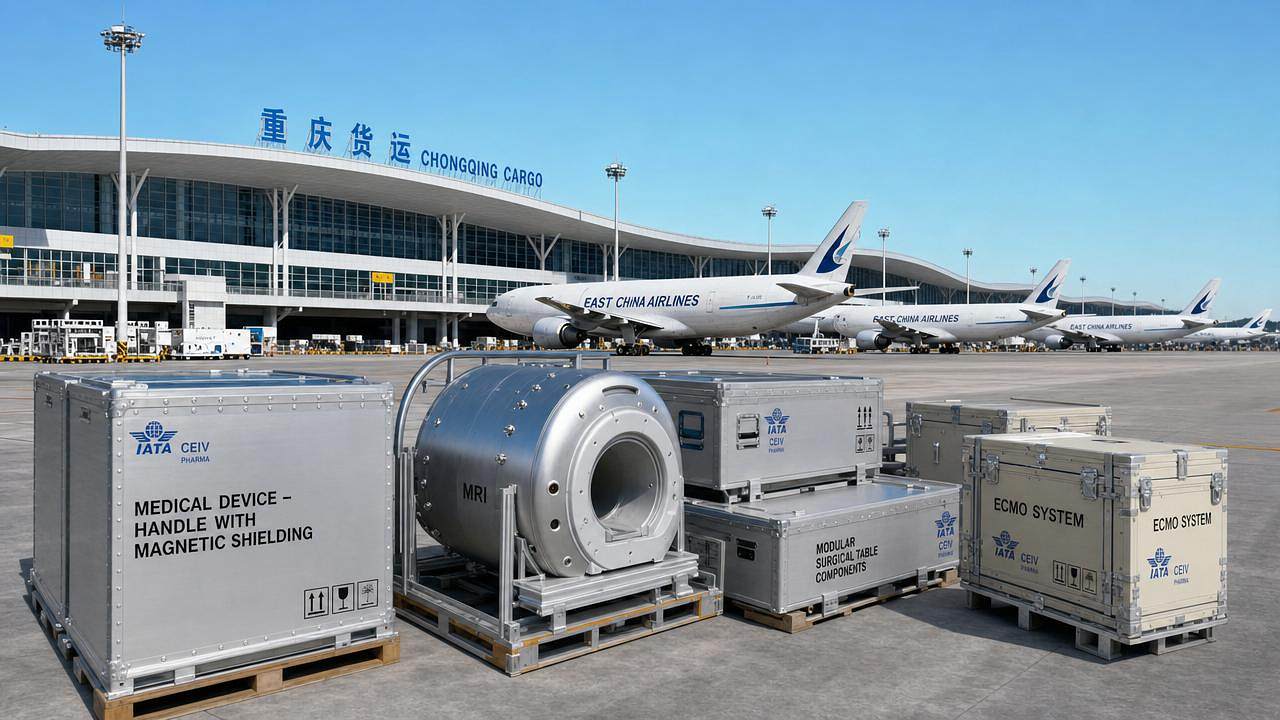




On May 17, 2026, East China Airlines Logistics and Chongqing Airport Group jointly launched East China Airlines Western Supply Chain (Chongqing), increasing air cargo capacity for high-end medical equipment exports from the Chengdu–Chongqing region by 35%—with direct implications for international exporters of superconducting MRI systems, digital operating rooms, and ECMO units.
Event Overview
On May 17, 2026, East China Airlines Logistics and Chongqing Airport Group announced the official commencement of operations for East China Airlines Western Supply Chain (Chongqing). The initiative introduces 12 dedicated weekly flights for medical equipment transport, prioritizing oversized and high-value items including superconducting MRI magnets, fully assembled digital operating tables, and ECMO systems. Following implementation, average air freight transit time for high-end medical equipment exported from the Chengdu–Chongqing region to Europe, the Middle East, and Southeast Asia has shortened by 2.3 days, with average freight rates reduced by 8%.
Industries Affected by This Development
Direct Exporters of Medical Devices
Exporters of superconducting MRI systems, digital operating rooms, and integrated ECMO solutions are directly affected because the new service targets precisely these high-complexity, time-sensitive, and dimensionally challenging products. The impact manifests in improved schedule reliability, lower landed costs, and expanded feasibility for air-freight-dependent markets where sea freight is impractical due to regulatory timelines or installation urgency.
Medical Equipment Manufacturers (OEMs & Contract Assemblers)
Manufacturers responsible for final integration—especially those shipping complete digital operating room suites or magnet-integrated MRI systems—face revised logistics planning requirements. The availability of dedicated weekly capacity means tighter coordination between production scheduling, packaging validation (e.g., for magnetic shielding or vibration control), and flight slot booking. Delays in documentation or dimensional certification may now result in missed weekly windows rather than flexible ad-hoc bookings.
International Distributors & Channel Partners
Distributors serving European, Middle Eastern, and Southeast Asian healthcare providers benefit from more predictable delivery lead times and margin stability due to freight cost reductions. However, they must adapt internal demand forecasting and inventory replenishment models to align with the fixed weekly frequency—not just volume increases—since capacity is scheduled, not on-demand.
Specialized Air Cargo Forwarders & Logistics Integrators
Forwarders offering end-to-end medical device logistics—including temperature-controlled handling, customs pre-clearance for dual-use items, and last-mile coordination with hospital engineering teams—now face intensified competition on service consistency. The dedicated flight structure raises client expectations for guaranteed cut-off times, real-time dimensional compliance checks, and coordinated ground-handling at both origin and destination airports.
What Relevant Enterprises or Practitioners Should Focus On Now
Monitor official operational guidelines and slot allocation procedures
East China Airlines Western Supply Chain (Chongqing) has not yet published public criteria for priority access, dimensional thresholds, or documentation requirements for the 12 weekly dedicated flights. Exporters and forwarders should track announcements from both East China Airlines Logistics and Chongqing Airport Group over Q3 2026 for formal eligibility frameworks.
Assess exposure to key destination markets and product categories
The 2.3-day transit improvement and 8% freight reduction apply specifically to shipments bound for Europe, the Middle East, and Southeast Asia—and only for confirmed eligible equipment types (superconducting MRI magnets, digital operating tables, ECMO systems). Companies exporting to other regions—or shipping ancillary components (e.g., non-magnet MRI subsystems, standalone surgical displays)—should verify applicability before adjusting logistics plans.
Distinguish between announced capacity and actual service maturity
While weekly flight frequency is confirmed, operational maturity—including consistent ramp-up of specialized ground handling, customs coordination for regulated medical devices, and contingency protocols for magnet quench events or battery-powered ECMO units—is still evolving. Early adopters should treat initial months as a phase-in period, not full-scale readiness.
Prepare packaging, documentation, and cross-departmental alignment now
Manufacturers and exporters should initiate internal reviews of current packaging certifications (e.g., IATA PI 950 compliance for lithium batteries in ECMO units), magnetic field emission reports for MRI magnets, and harmonized system descriptions for digital OR configurations. Aligning sales, logistics, regulatory affairs, and quality departments ahead of formal slot booking opens will reduce onboarding friction.
Editorial Perspective / Industry Observation
Observably, this development functions primarily as an infrastructure signal—not yet a fully scaled outcome. The launch confirms strategic intent to strengthen air logistics for high-value, low-volume medical exports from Western China, but its tangible impact remains contingent on execution fidelity across customs, ground handling, and interline coordination. Analysis shows that while the 35% capacity increase is quantifiable, its real-world utility depends less on flight count and more on consistent adherence to medical device-specific handling standards. From an industry perspective, this initiative reflects a broader shift: air cargo networks are increasingly being segmented by product class rather than generalized freight categories—a trend likely to accelerate as regulatory and clinical timelines compress globally. Current attention should therefore focus less on headline metrics and more on how reliably the dedicated flights uphold technical and compliance requirements across the entire chain.
Ultimately, East China Airlines Western Supply Chain (Chongqing) represents a targeted upgrade—not a systemic overhaul—of air logistics capability for a narrow but high-stakes segment of medical trade. Its significance lies not in scale alone, but in its specificity: it acknowledges that superconducting MRI magnets and digital operating rooms cannot be treated like standard air cargo. For stakeholders, the most rational interpretation is pragmatic readiness—not immediate transformation.
Source: Official joint announcement by East China Airlines Logistics and Chongqing Airport Group, dated May 17, 2026.
Note: Ongoing observation is warranted regarding slot allocation rules, dimensional compliance thresholds, and cross-border customs facilitation mechanisms—none of which have been publicly detailed as of publication.
Recommended News
 Oct 06, 2026How to Evaluate an Operating Room Technology Distributor for Hospital ProjectsOperating room technology distributor evaluation guide for hospitals: assess integration, compliance, lifecycle costs, service capacity, and delivery confidence before award.
 Oct 05, 2026Global Medical Procurement Planning: How Hospitals Can Reduce Supply Risk and CostGlobal medical procurement planning helps hospitals reduce supply risk, control lifecycle costs, and protect care continuity through smarter sourcing, service, and compliance strategies.
 Oct 03, 2026How Detection Algorithms Improve Sensitivity and Workflow in Medical ImagingMedical imaging algorithms detection improves sensitivity, manages false positives, and streamlines clinical workflows. Explore validation, integration, and governance essentials.
 Oct 02, 2026High-Flow ICU Ventilators: Key Selection Criteria for Acute Respiratory CareICU ventilators high flow: discover key selection criteria for accurate gas delivery, NIV performance, humidification, alarms, reliability, and safer acute respiratory care.
 Oct 01, 2026How to Evaluate Medical Equipment Intelligence Suppliers for Hospital ProcurementMedical equipment intelligence suppliers: learn how hospitals can assess evidence quality, total cost, compliance, interoperability, and cybersecurity for smarter procurement decisions.
 Sep 30, 2026ISO 13485 Requirements for Blood Testing Instruments: A Buyer’s ChecklistBlood testing instruments ISO 13485 buyer’s checklist: verify certification scope, traceability, installation, consumables, and supplier support before you buy.
 Sep 29, 2026How to Evaluate Integrated Operating Room Systems for Workflow, Imaging, and IT IntegrationIntegrated operating room systems: evaluate workflow, imaging, IT integration, cybersecurity, and lifecycle value to select a scalable surgical solution.
 Sep 28, 2026How to Evaluate a Genetic Testing Equipment Supplier for PCR Lab ProcurementGenetic testing equipment supplier evaluation guide for PCR labs: compare performance, compliance, workflow, service, supply resilience, and total cost.
 Sep 27, 2026How to Specify Custom Benchtop Diagnostic Instruments for Your Assay WorkflowCustom diagnostic instruments benchtop guide: specify optics, fluidics, automation, software integration, and support to build a reliable assay workflow.
 Sep 26, 2026How Cardiac Imaging Analysis Tools Turn CT and MRI Data into Clinical MetricsMedical imaging analysis cardiology tools transform cardiac CT and MRI into reliable metrics. Explore segmentation, validation, workflow integration, and AI review.
 Sep 25, 2026How Iterative Image Reconstruction Algorithms Balance CT Dose, Noise, and DetailIterative image reconstruction algorithms help CT teams balance dose, noise, and diagnostic detail. Explore practical insights for confident imaging decisions.
 Sep 24, 2026What Drives the Total Cost of Medical Technology Solutions Over Their Lifecycle?Medical technology solutions cost goes far beyond purchase price—explore lifecycle drivers from installation and service to software, training, compliance, and downtime.
 Sep 24, 2026Diagnostic Imaging Technology: How Modalities Support Different Clinical DecisionsDiagnostic imaging technology supports smarter clinical decisions across CT, MRI, ultrasound, and nuclear imaging. Explore modality strengths, workflows, and selection factors.
 Sep 22, 2026How Life Science Labs Can Select Biomedical Research Equipment by Workflow and ThroughputBiomedical research equipment life science labs can select with confidence by aligning workflow, throughput, automation, data integrity, and scalable support.
 Sep 21, 2026How to Plan LIS Connectivity for Chemiluminescence Analyzers Without Data GapsChemiluminescence analyzers LIS connectivity: learn how to prevent data gaps with field mapping, exception workflows, end-to-end validation, and reliable go-live planning.
 Sep 20, 2026Selecting Fluorescence PCR Instruments: Detection Channels, Sensitivity, and Workflow FitPCR diagnostic instruments fluorescence detection guide: compare channels, sensitivity, multiplexing, and workflow fit to select a reliable platform.
 Sep 19, 2026Biomedical Signal Processing: From Sensor Data to Clinical Decision SupportBiomedical signal processing transforms sensor data into reliable clinical decision support. Explore AI, imaging, IVD, ICU monitoring, and compliance-ready MedTech insights.
 Sep 18, 2026How to Evaluate a Diagnostic Imaging Platform for Multi-Modality Workflow IntegrationDiagnostic imaging platform evaluation guide: assess multi-modality workflows, interoperability, AI integration, image integrity, security, and scalability for safer clinical decisions.
 Sep 17, 2026ISO 13485 for Medical Imaging Equipment: What Manufacturers Must DocumentMedical imaging equipment ISO 13485: discover essential documentation for design controls, risk management, traceability, software, and post-market quality.
 Sep 16, 2026Robotic MIS Equipment: What Hospitals Should Evaluate Before AdoptionMinimally invasive surgical equipment robotic adoption guide: evaluate workflow, safety, imaging, costs, cybersecurity, and service readiness.
 Sep 15, 2026How to Evaluate Biomedical Signal Processing Suppliers for Clinical Device ProjectsBiomedical signal processing supplier evaluation guide for clinical device teams—compare signal fidelity, regulatory evidence, cybersecurity, integration, and lifecycle support.
 Sep 14, 2026How Integrated Clinical Diagnostics Solutions Reduce Turnaround Time Across Lab WorkflowsIntegrated clinical diagnostics solutions reduce lab turnaround time by connecting workflows, automation, and data. Discover practical strategies for faster, traceable results.
 Sep 13, 2026ECMO System Market Outlook: Demand Drivers, Investment Risks, and Growth OpportunitiesECMO system market outlook explores demand drivers, investment risks, regulatory factors, and growth opportunities shaping critical-care innovation and adoption.
 Sep 12, 2026Where to Find Reliable Medical Device Information for Research and Due DiligenceMedical device information resource guide for due diligence: verify regulatory, clinical, safety, and technical evidence to make confident decisions.


















Related News
- 00
0000-00
China Temporarily Bans Helium Exports - 00
0000-00
How to Evaluate MRI Systems for Neurology: Key Imaging Needs and Selection Criteria - 00
0000-00
MDCG Tightens CE Rules for AI MRI Reconstruction - 00
0000-00
PMDA Fast Track Adds Conditional Path for MRI AI - 00
0000-00
PMDA Fast Track Expansion Opens Conditional Route for MRI AI
Weekly Insights
Stay ahead with our curated technology reports delivered every Monday.