
Photon-Counting CT Detector Airfreight Costs Surge
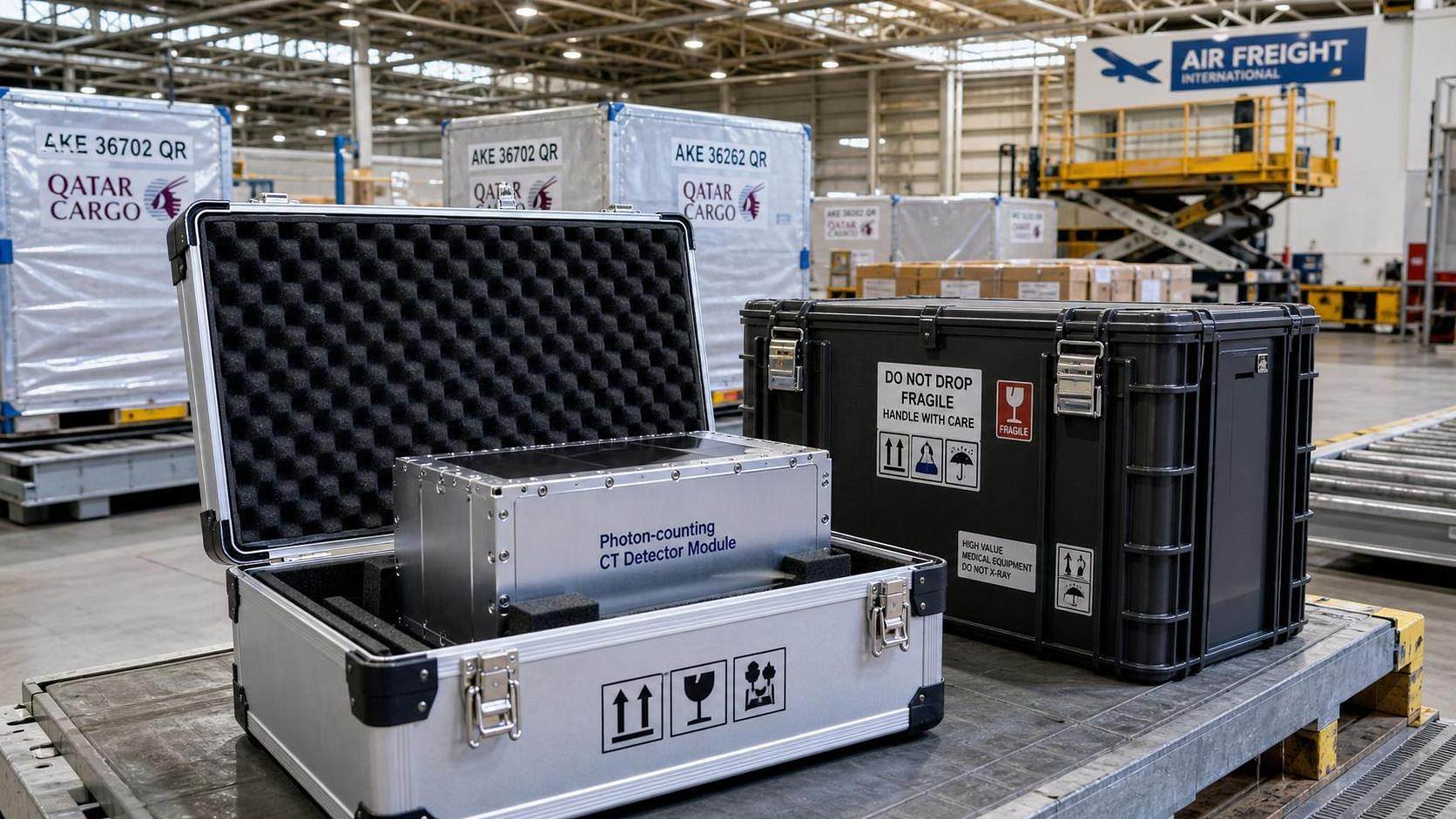




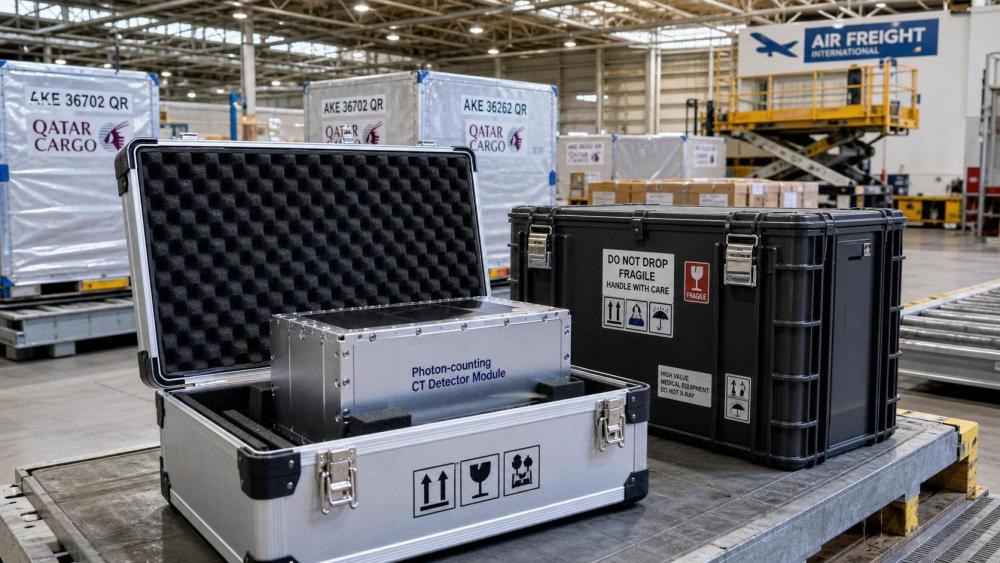
The timing of the underlying disruption was not specified in the input, but the latest logistics update cited here points to a sharp escalation in transport pressure for Photon-counting CT detector supply. According to the FIATA global medical device logistics brief dated July 4, 2026, airfreight quotes from Jebel Ali for Europe and North America routes for dedicated CdTe/CZT detectors used in Photon-counting CT have climbed to $18,200/kg, up 195% year over year, while major freight forwarders have suspended new bookings. For CT system manufacturers, component buyers, and supply chain service providers, this matters because it shifts the issue from routine freight volatility to a direct constraint on delivery planning and sourcing decisions.
What Has Been Confirmed So Far
The confirmed information is limited but commercially significant. The FIATA medical equipment logistics brief dated July 4, 2026 stated that continued attacks by the Houthis have affected logistics conditions tied to Jebel Ali port routes serving Europe and North America. In that context, airfreight pricing for Photon-counting CT-specific CdTe/CZT detectors reached $18,200 per kilogram, representing a 195% year-over-year increase.
The same input states that major freight forwarders have paused order intake for these shipments. It also states that average delivery cycles for current orders have extended from 12 weeks to 24-28 weeks. In response, multiple Chinese CT system manufacturers have begun evaluating alternative secondary packaging options in Southeast Asia.
Where the Pressure Lands Across the Chain
System makers face a direct delivery risk
From an industry perspective, CT OEMs and integrators are the most immediately exposed because the reported disruption affects a key detector category tied to Photon-counting CT. The impact is likely to show up first in production scheduling, customer delivery commitments, and procurement timing. What deserves closer attention is whether extended lead times force changes in build plans, inventory buffers, or route selection.
Component procurement teams are dealing with both price and access
For procurement functions, the issue is not only the quoted jump in freight cost but also the reported suspension of new bookings by mainstream forwarders. That combination can turn a pricing problem into an availability problem. Teams handling detector sourcing will need to watch whether quoted freight remains obtainable in practice and whether lead time assumptions used in purchase planning are still valid.
Logistics providers are now part of the operational bottleneck
Supply chain service providers and freight coordinators may be affected because the report points to a market where benchmark pricing has risen sharply while booking capacity has tightened. Analysis shows that in such a setting, routing feasibility, booking acceptance, and shipment prioritization become as important as headline cost. For service providers, the critical variable is no longer only transport execution, but whether they can secure a workable path at all.
Downstream buyers may see schedule uncertainty before other effects
For procurement-side customers and downstream project teams, the first likely consequence is schedule uncertainty rather than an immediately visible end-market conclusion. Observably, a move from 12 weeks to 24-28 weeks changes planning assumptions for deliveries, installation windows, and internal approvals. The input does not confirm broader market outcomes, but it clearly signals that timing risk has increased.
What Companies Should Track Now
Check whether quoted freight is still bookable
The input indicates both a steep quote increase and a pause in new bookings from major forwarders. In practical terms, companies should separate nominal price information from actual shipment availability. A quote alone is no longer enough for planning if booking acceptance is uncertain.
Rework lead-time commitments in active orders
Because the average delivery window has reportedly stretched to 24-28 weeks, teams managing open orders should review whether legacy timelines, contract milestones, and customer communications still reflect current conditions. This is especially relevant where detector availability sits on the critical path.
Assess substitute supply-chain configurations carefully
The input notes that several Chinese CT manufacturers have started evaluating Southeast Asia secondary packaging alternatives. Analysis shows that this is a concrete signal worth following, but it should not be treated as a confirmed solution. Companies reviewing similar options should focus on execution feasibility, supplier qualification status, and whether an alternative path improves timeline certainty rather than only lowering headline cost.
Keep documentation and counterpart communication current
Where transport conditions are changing quickly, supplier communication, shipment status updates, and order documentation become more important. What deserves closer attention is whether each party in the chain is working from the same assumptions on lead time, routing, and delivery sequence, since misalignment can create avoidable delays even before physical shipment begins.
Why This Looks More Like a Supply Signal Than a One-Off Freight Move
Analysis shows that this update should not be read only as a logistics cost story. The combination of a 195% year-over-year increase in airfreight quotes, paused booking intake by mainstream forwarders, and a doubling of average delivery cycles suggests pressure on supply continuity for a highly specific component category. That said, the input does not establish a permanent structural shift, and it does not confirm broader market outcomes beyond the reported transport and lead-time changes.
It is more appropriate to understand this as a developing industry signal: the logistics route disruption is already affecting a critical part of the Photon-counting CT supply chain, but the duration, spread, and eventual procurement response still require continued observation.
How This Update Is Best Interpreted for Now
At this stage, the most balanced reading is that the reported disruption has moved beyond ordinary freight volatility and into a material planning issue for detector-dependent CT programs. The confirmed facts support caution on cost, booking availability, and delivery timing. They do not yet support sweeping conclusions about long-term market outcomes. For industry participants, this is best treated as an active risk signal with immediate operational relevance and an uncertain longer tail.
Basis of This Report and What Still Needs Verification
This article is based on the user-provided news title, event timing, and event summary. The specific official source link was not provided in the input, so the underlying claims still require ongoing verification against source materials when available. For this type of development, commonly relevant source categories include official statements, company disclosures, industry association updates, authoritative media reporting, and standard-setting or trade documentation.
Further monitoring should focus on whether booking suspensions continue, whether the reported 24-28 week delivery range changes again, and whether the evaluation of Southeast Asia secondary packaging alternatives develops into broader implementation across the supply chain.
Recommended News
 Oct 03, 2026How Detection Algorithms Improve Sensitivity and Workflow in Medical ImagingMedical imaging algorithms detection improves sensitivity, manages false positives, and streamlines clinical workflows. Explore validation, integration, and governance essentials.
 Oct 02, 2026High-Flow ICU Ventilators: Key Selection Criteria for Acute Respiratory CareICU ventilators high flow: discover key selection criteria for accurate gas delivery, NIV performance, humidification, alarms, reliability, and safer acute respiratory care.
 Oct 01, 2026How to Evaluate Medical Equipment Intelligence Suppliers for Hospital ProcurementMedical equipment intelligence suppliers: learn how hospitals can assess evidence quality, total cost, compliance, interoperability, and cybersecurity for smarter procurement decisions.
 Sep 30, 2026ISO 13485 Requirements for Blood Testing Instruments: A Buyer’s ChecklistBlood testing instruments ISO 13485 buyer’s checklist: verify certification scope, traceability, installation, consumables, and supplier support before you buy.
 Sep 29, 2026How to Evaluate Integrated Operating Room Systems for Workflow, Imaging, and IT IntegrationIntegrated operating room systems: evaluate workflow, imaging, IT integration, cybersecurity, and lifecycle value to select a scalable surgical solution.
 Sep 28, 2026How to Evaluate a Genetic Testing Equipment Supplier for PCR Lab ProcurementGenetic testing equipment supplier evaluation guide for PCR labs: compare performance, compliance, workflow, service, supply resilience, and total cost.
 Sep 27, 2026How to Specify Custom Benchtop Diagnostic Instruments for Your Assay WorkflowCustom diagnostic instruments benchtop guide: specify optics, fluidics, automation, software integration, and support to build a reliable assay workflow.
 Sep 26, 2026How Cardiac Imaging Analysis Tools Turn CT and MRI Data into Clinical MetricsMedical imaging analysis cardiology tools transform cardiac CT and MRI into reliable metrics. Explore segmentation, validation, workflow integration, and AI review.
 Sep 25, 2026How Iterative Image Reconstruction Algorithms Balance CT Dose, Noise, and DetailIterative image reconstruction algorithms help CT teams balance dose, noise, and diagnostic detail. Explore practical insights for confident imaging decisions.
 Sep 24, 2026What Drives the Total Cost of Medical Technology Solutions Over Their Lifecycle?Medical technology solutions cost goes far beyond purchase price—explore lifecycle drivers from installation and service to software, training, compliance, and downtime.
 Sep 24, 2026Diagnostic Imaging Technology: How Modalities Support Different Clinical DecisionsDiagnostic imaging technology supports smarter clinical decisions across CT, MRI, ultrasound, and nuclear imaging. Explore modality strengths, workflows, and selection factors.
 Sep 22, 2026How Life Science Labs Can Select Biomedical Research Equipment by Workflow and ThroughputBiomedical research equipment life science labs can select with confidence by aligning workflow, throughput, automation, data integrity, and scalable support.
 Sep 21, 2026How to Plan LIS Connectivity for Chemiluminescence Analyzers Without Data GapsChemiluminescence analyzers LIS connectivity: learn how to prevent data gaps with field mapping, exception workflows, end-to-end validation, and reliable go-live planning.
 Sep 20, 2026Selecting Fluorescence PCR Instruments: Detection Channels, Sensitivity, and Workflow FitPCR diagnostic instruments fluorescence detection guide: compare channels, sensitivity, multiplexing, and workflow fit to select a reliable platform.
 Sep 19, 2026Biomedical Signal Processing: From Sensor Data to Clinical Decision SupportBiomedical signal processing transforms sensor data into reliable clinical decision support. Explore AI, imaging, IVD, ICU monitoring, and compliance-ready MedTech insights.
 Sep 18, 2026How to Evaluate a Diagnostic Imaging Platform for Multi-Modality Workflow IntegrationDiagnostic imaging platform evaluation guide: assess multi-modality workflows, interoperability, AI integration, image integrity, security, and scalability for safer clinical decisions.
 Sep 17, 2026ISO 13485 for Medical Imaging Equipment: What Manufacturers Must DocumentMedical imaging equipment ISO 13485: discover essential documentation for design controls, risk management, traceability, software, and post-market quality.
 Sep 16, 2026Robotic MIS Equipment: What Hospitals Should Evaluate Before AdoptionMinimally invasive surgical equipment robotic adoption guide: evaluate workflow, safety, imaging, costs, cybersecurity, and service readiness.
 Sep 15, 2026How to Evaluate Biomedical Signal Processing Suppliers for Clinical Device ProjectsBiomedical signal processing supplier evaluation guide for clinical device teams—compare signal fidelity, regulatory evidence, cybersecurity, integration, and lifecycle support.
 Sep 14, 2026How Integrated Clinical Diagnostics Solutions Reduce Turnaround Time Across Lab WorkflowsIntegrated clinical diagnostics solutions reduce lab turnaround time by connecting workflows, automation, and data. Discover practical strategies for faster, traceable results.
 Sep 13, 2026ECMO System Market Outlook: Demand Drivers, Investment Risks, and Growth OpportunitiesECMO system market outlook explores demand drivers, investment risks, regulatory factors, and growth opportunities shaping critical-care innovation and adoption.
 Sep 12, 2026Where to Find Reliable Medical Device Information for Research and Due DiligenceMedical device information resource guide for due diligence: verify regulatory, clinical, safety, and technical evidence to make confident decisions.
 Sep 11, 2026Medical Equipment Intelligence: A Resource for Comparing Clinical TechnologiesMedical equipment intelligence resource for comparing clinical technologies by clinical fit, compliance, workflow, and total cost—make confident, evidence-led decisions.
 Sep 10, 2026How to Integrate Application-Specific Medical Solutions Into Existing Clinical WorkflowsApplication-specific medical solutions integration: learn how to align clinical workflows, interoperability, safety, and measurable outcomes for reliable deployment.





















Related News
- 00
0000-00
Is Photon-Counting CT Clinically Better Than Conventional CT for Exporters? - 00
0000-00
How CT Reconstruction Technology Impacts Image Quality, Dose, and Workflow - 00
0000-00
EU Tightens MDR Transition for Photon-Counting CT - 00
0000-00
What Low-Dose Imaging Innovations Matter Most When Evaluating New CT Systems? - 00
0000-00
EFTA Requires NdFeB Carbon Disclosure for Photon-counting CT
Weekly Insights
Stay ahead with our curated technology reports delivered every Monday.