
Red Sea Disruption Pushes ECMO Freight Up 210%
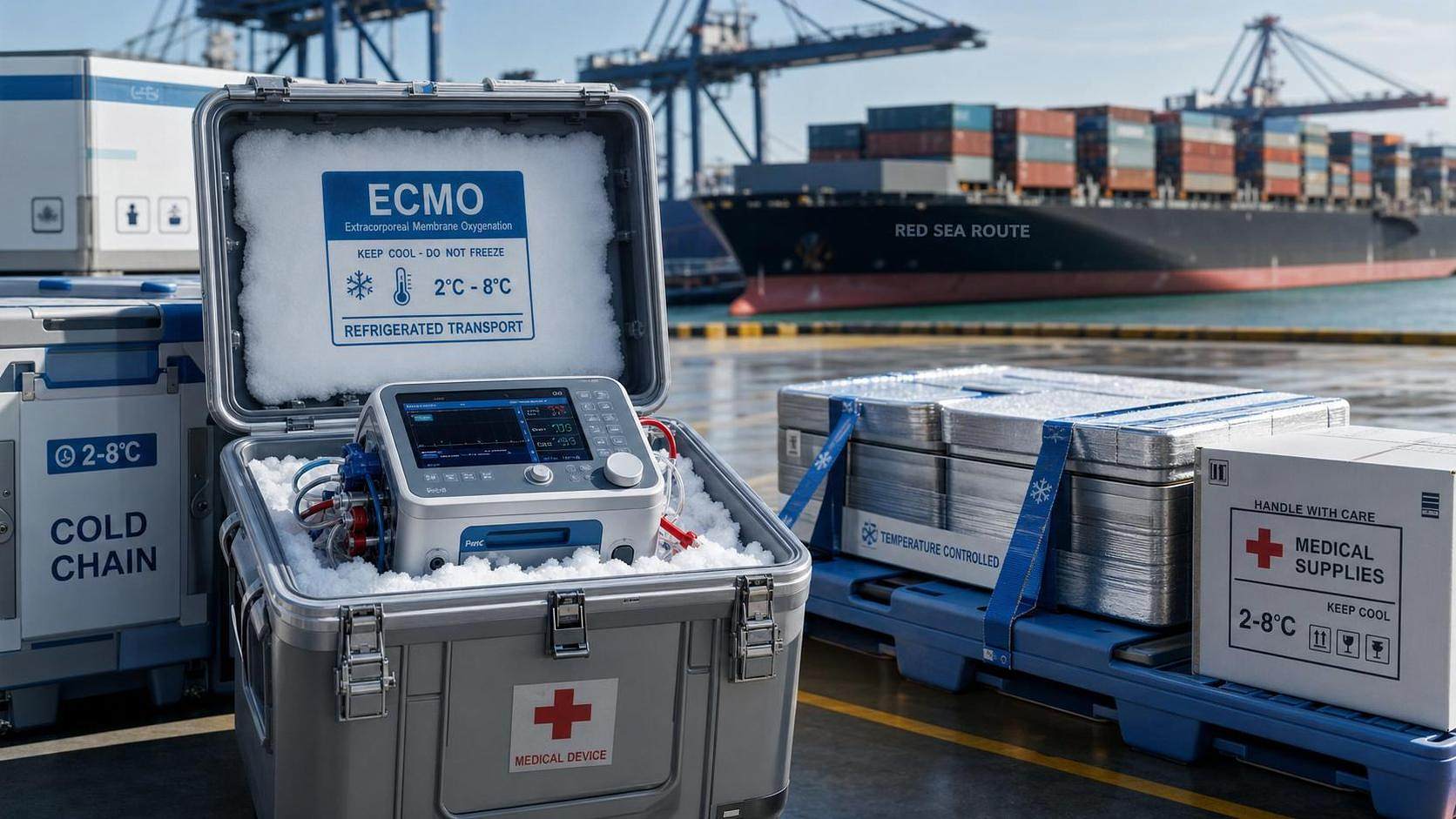




On July 1, 2026, a new logistics warning for medical devices highlighted a shift that matters beyond transport pricing: route disruption in the Red Sea is now changing delivery conditions for ECMO systems and other ultra-low-temperature-sensitive life-support equipment. For exporters, buyers, distributors, and supply chain service providers, the issue is no longer only freight volatility, but how transport mode changes affect delivery commitments, cold-chain continuity, customs handling, and practical compliance in cross-border execution.
What the latest logistics warning confirms
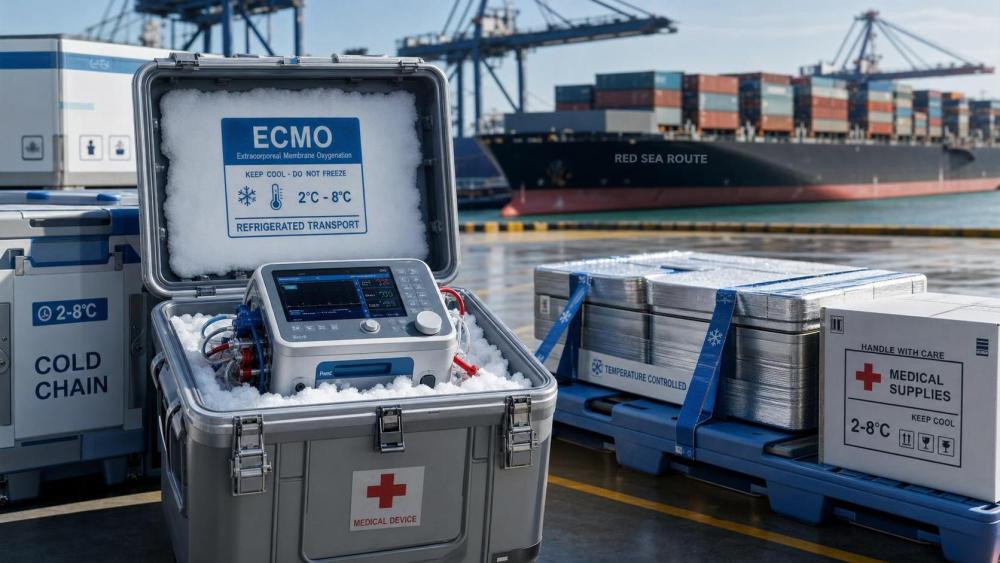
According to a July 2026 global medical device logistics alert jointly released by Maersk and DHL, continued attacks by Houthi forces have made vessel diversion around the Cape of Good Hope a routine condition on the Red Sea route. For ECMO Systems and other ultra-low-temperature-sensitive life-support devices, air cargo space has become tight. In the first week of July, the average air freight cost reached $18,600 per unit, up 210% year on year.
The same alert states that most exporters have shifted toward temperature-controlled sea containers supported by dry ice. It also states that customs clearance and the handoff into last-mile cold-chain operations have extended delivery cycles to a stable range of 18 to 22 working days, which is 9 days longer than the 2025 average.
Where the operational pressure is likely to fall
Export execution is becoming more document- and timing-sensitive
From an industry perspective, exporters of sensitive medical equipment are likely to feel the impact first because the change is tied directly to transport mode and transit time. When shipments move from scarce air capacity to temperature-controlled sea transport with dry ice support, delivery planning, shipment scheduling, and proof of handling become more critical. What deserves closer attention is whether shipping documents, temperature-control records, and handover arrangements are robust enough to support delayed but controlled delivery.
Procurement teams may need to revisit lead-time assumptions
Buyers and procurement functions are also exposed because the reported delivery window has moved to 18 to 22 working days. Analysis shows that this affects ordering rhythm, replenishment timing, and acceptance planning more than headline freight cost alone. For equipment categories tied to treatment readiness, procurement teams should pay close attention to whether tender documents, purchase terms, or internal delivery benchmarks still reflect the earlier logistics baseline.
Distribution and cold-chain service links face tighter coordination demands
Distributors and supply chain service providers are likely to face more coordination pressure at customs and in the final cold-chain leg, since the summary identifies those two points as the main causes of extended lead times. Observably, the operational risk here is not a newly announced regulation, but a stricter practical threshold for execution: if customs handling and last-mile cold-chain transfer are not aligned, transit extension can directly affect delivery reliability.
After-sales and traceability functions may need closer shipment tracking
For after-sales teams and quality traceability functions, longer and more complex transport routes can raise the importance of shipment visibility and condition records. It is more appropriate to understand this as an execution-side compliance issue rather than a confirmed new certification rule. The immediate concern is whether handoff records, transport logs, and delivery evidence remain sufficient when the route and timing profile change materially.
What companies should watch now
Review whether current delivery commitments remain realistic
Analysis shows that companies should closely review whether existing contract timelines, quoted delivery dates, and internal service commitments still match the reported 18 to 22 working day range. Where commitments were built around faster routing or more available air freight, the gap may now affect order execution and customer communication.
Check cold-chain documentation and transport records
Because more exporters are moving to temperature-controlled sea containers with dry ice support, companies should pay attention to whether their shipping files, handling instructions, and condition records are adequate for a longer transit cycle. The input does not provide detailed execution standards, so this should be treated as a compliance checkpoint to monitor rather than a confirmed new filing requirement.
Monitor customs and final-mile handoff performance
What deserves closer attention is the practical interaction between customs clearance and last-mile cold-chain transfer, since the summary identifies those links as central to the longer delivery cycle. Companies involved in export, import, or onward distribution should track whether delays are emerging at one point or across the whole chain, and whether additional supporting documents or coordination steps are becoming necessary in practice.
Watch for changes in procurement and bid documentation
Observably, if longer delivery windows remain stable, procurement documents, service-level expectations, and technical or commercial bid responses may need adjustment. The current information does not confirm any formal rule revision in tendering or certification language, but it does signal that companies should watch closely for changes in customer documentation, delivery clauses, and execution expectations.
Why this looks more like an execution signal than a formal rule rewrite
Analysis shows that this development is best read as a strong execution signal rather than a standalone new regulation. The confirmed facts point to a logistics environment in which route diversion, scarce air capacity, and longer sea-based cold-chain delivery are becoming normalized for a sensitive category of medical equipment. From an industry perspective, the significance lies in how these conditions can tighten real-world compliance expectations around delivery evidence, shipment condition control, and procurement timing even before any formal documentation framework is rewritten.
At the same time, it would be premature to treat this as a settled regulatory outcome. Observably, the market still needs to watch how buyers, logistics operators, and compliance teams respond in practice, especially where delivery terms and quality traceability depend on stable cold-chain performance.
How this update is best understood at this stage
The most reasonable reading of this event is that logistics disruption is now functioning as an operational rule change for cross-border delivery of highly sensitive medical devices. It does not by itself confirm a new certification regime or a new formal trade rule, but it clearly changes the baseline for freight cost, transport choice, and lead-time planning. For the industry, the immediate value of this update is in resetting execution assumptions and watching whether those assumptions begin to appear in procurement, delivery, and compliance practice.
Basis of this article and what still needs verification
This article is based on the user-provided news title, event date, and event summary. For events of this kind, relevant source categories typically include official notices, regulator releases, customs or trade authority information, industry association updates, standards organization documents, and reporting by authoritative media. A specific official source link was not provided in the input, so the underlying references still need ongoing verification.
Further observation is still needed on any later policy detail, certification interpretation, procurement document changes, industry feedback, and company-level execution practice that may emerge from this logistics disruption.
Recommended News
 Oct 02, 2026High-Flow ICU Ventilators: Key Selection Criteria for Acute Respiratory CareICU ventilators high flow: discover key selection criteria for accurate gas delivery, NIV performance, humidification, alarms, reliability, and safer acute respiratory care.
 Oct 01, 2026How to Evaluate Medical Equipment Intelligence Suppliers for Hospital ProcurementMedical equipment intelligence suppliers: learn how hospitals can assess evidence quality, total cost, compliance, interoperability, and cybersecurity for smarter procurement decisions.
 Sep 30, 2026ISO 13485 Requirements for Blood Testing Instruments: A Buyer’s ChecklistBlood testing instruments ISO 13485 buyer’s checklist: verify certification scope, traceability, installation, consumables, and supplier support before you buy.
 Sep 29, 2026How to Evaluate Integrated Operating Room Systems for Workflow, Imaging, and IT IntegrationIntegrated operating room systems: evaluate workflow, imaging, IT integration, cybersecurity, and lifecycle value to select a scalable surgical solution.
 Sep 28, 2026How to Evaluate a Genetic Testing Equipment Supplier for PCR Lab ProcurementGenetic testing equipment supplier evaluation guide for PCR labs: compare performance, compliance, workflow, service, supply resilience, and total cost.
 Sep 27, 2026How to Specify Custom Benchtop Diagnostic Instruments for Your Assay WorkflowCustom diagnostic instruments benchtop guide: specify optics, fluidics, automation, software integration, and support to build a reliable assay workflow.
 Sep 26, 2026How Cardiac Imaging Analysis Tools Turn CT and MRI Data into Clinical MetricsMedical imaging analysis cardiology tools transform cardiac CT and MRI into reliable metrics. Explore segmentation, validation, workflow integration, and AI review.
 Sep 25, 2026How Iterative Image Reconstruction Algorithms Balance CT Dose, Noise, and DetailIterative image reconstruction algorithms help CT teams balance dose, noise, and diagnostic detail. Explore practical insights for confident imaging decisions.
 Sep 24, 2026What Drives the Total Cost of Medical Technology Solutions Over Their Lifecycle?Medical technology solutions cost goes far beyond purchase price—explore lifecycle drivers from installation and service to software, training, compliance, and downtime.
 Sep 24, 2026Diagnostic Imaging Technology: How Modalities Support Different Clinical DecisionsDiagnostic imaging technology supports smarter clinical decisions across CT, MRI, ultrasound, and nuclear imaging. Explore modality strengths, workflows, and selection factors.
 Sep 22, 2026How Life Science Labs Can Select Biomedical Research Equipment by Workflow and ThroughputBiomedical research equipment life science labs can select with confidence by aligning workflow, throughput, automation, data integrity, and scalable support.
 Sep 21, 2026How to Plan LIS Connectivity for Chemiluminescence Analyzers Without Data GapsChemiluminescence analyzers LIS connectivity: learn how to prevent data gaps with field mapping, exception workflows, end-to-end validation, and reliable go-live planning.
 Sep 20, 2026Selecting Fluorescence PCR Instruments: Detection Channels, Sensitivity, and Workflow FitPCR diagnostic instruments fluorescence detection guide: compare channels, sensitivity, multiplexing, and workflow fit to select a reliable platform.
 Sep 19, 2026Biomedical Signal Processing: From Sensor Data to Clinical Decision SupportBiomedical signal processing transforms sensor data into reliable clinical decision support. Explore AI, imaging, IVD, ICU monitoring, and compliance-ready MedTech insights.
 Sep 18, 2026How to Evaluate a Diagnostic Imaging Platform for Multi-Modality Workflow IntegrationDiagnostic imaging platform evaluation guide: assess multi-modality workflows, interoperability, AI integration, image integrity, security, and scalability for safer clinical decisions.
 Sep 17, 2026ISO 13485 for Medical Imaging Equipment: What Manufacturers Must DocumentMedical imaging equipment ISO 13485: discover essential documentation for design controls, risk management, traceability, software, and post-market quality.
 Sep 16, 2026Robotic MIS Equipment: What Hospitals Should Evaluate Before AdoptionMinimally invasive surgical equipment robotic adoption guide: evaluate workflow, safety, imaging, costs, cybersecurity, and service readiness.
 Sep 15, 2026How to Evaluate Biomedical Signal Processing Suppliers for Clinical Device ProjectsBiomedical signal processing supplier evaluation guide for clinical device teams—compare signal fidelity, regulatory evidence, cybersecurity, integration, and lifecycle support.
 Sep 14, 2026How Integrated Clinical Diagnostics Solutions Reduce Turnaround Time Across Lab WorkflowsIntegrated clinical diagnostics solutions reduce lab turnaround time by connecting workflows, automation, and data. Discover practical strategies for faster, traceable results.
 Sep 13, 2026ECMO System Market Outlook: Demand Drivers, Investment Risks, and Growth OpportunitiesECMO system market outlook explores demand drivers, investment risks, regulatory factors, and growth opportunities shaping critical-care innovation and adoption.
 Sep 12, 2026Where to Find Reliable Medical Device Information for Research and Due DiligenceMedical device information resource guide for due diligence: verify regulatory, clinical, safety, and technical evidence to make confident decisions.
 Sep 11, 2026Medical Equipment Intelligence: A Resource for Comparing Clinical TechnologiesMedical equipment intelligence resource for comparing clinical technologies by clinical fit, compliance, workflow, and total cost—make confident, evidence-led decisions.
 Sep 10, 2026How to Integrate Application-Specific Medical Solutions Into Existing Clinical WorkflowsApplication-specific medical solutions integration: learn how to align clinical workflows, interoperability, safety, and measurable outcomes for reliable deployment.
 Sep 09, 2026Medical Supplier Evaluation Checklist: How to Verify Quality, Compliance, and Delivery RiskMedical supplier evaluation checklist for verifying quality, compliance, service capacity, configuration accuracy, and delivery risk before purchase approval.





















Related News
- 00
0000-00
ECMO System Market Outlook: Demand Drivers, Investment Risks, and Growth Opportunities - 00
0000-00
What After-Sales Technical Support Is Expected for Life-Support Exports? - 00
0000-00
ECMO System Market Outlook: How Hospitals Assess Capacity and Investment Needs - 00
0000-00
FDA Approval of AMDS Hybrid Prosthesis Removes IRB Step for Faster U.S. Access - 00
0000-00
EU MDR Deadline Extended for ECMO and ICU Devices
Weekly Insights
Stay ahead with our curated technology reports delivered every Monday.