
FDA Mandates Matter 1.3 for ECMO Systems by Dec 2026
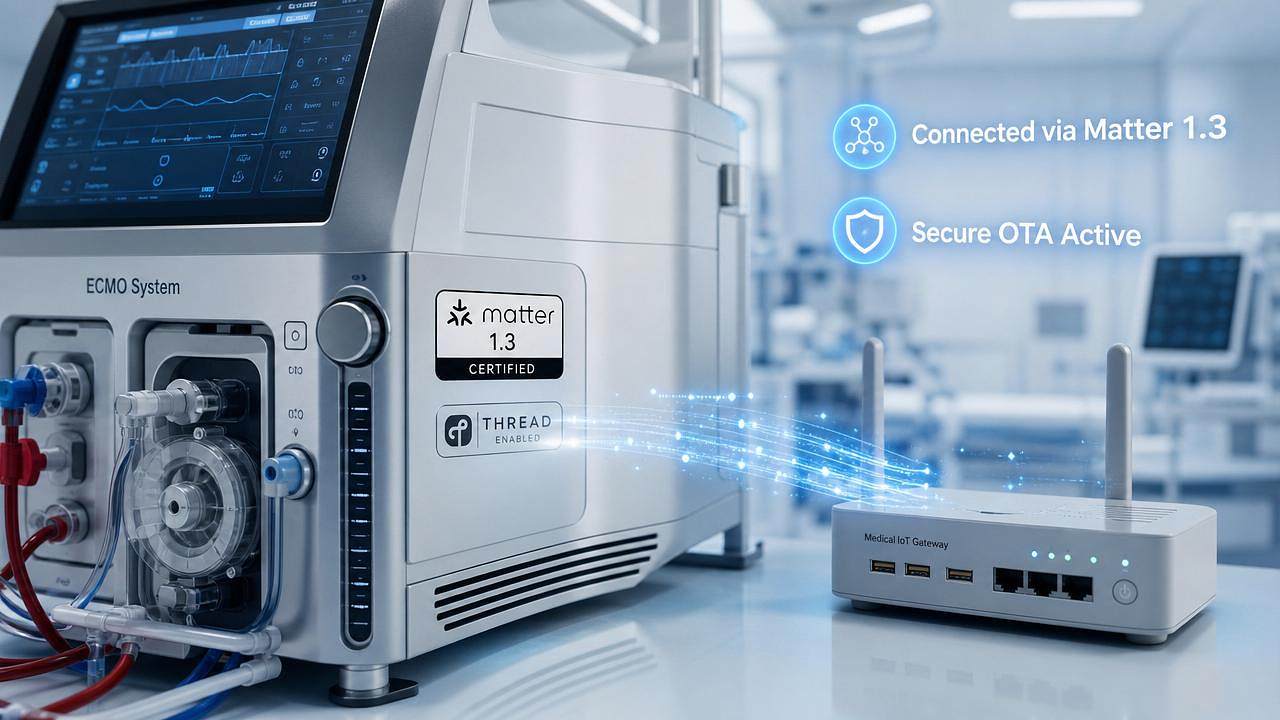




On May 31, 2026, the U.S. Food and Drug Administration (FDA) issued Revision 3 of its ECMO Systems Cybersecurity Guidance, introducing a new interoperability requirement: all newly registered extracorporeal membrane oxygenation (ECMO) systems must support the Matter 1.3 protocol to ensure secure integration with hospital IoT platforms. This regulatory shift directly impacts manufacturers—particularly those based in China—across hardware design, firmware development, and FDA premarket submission strategies.
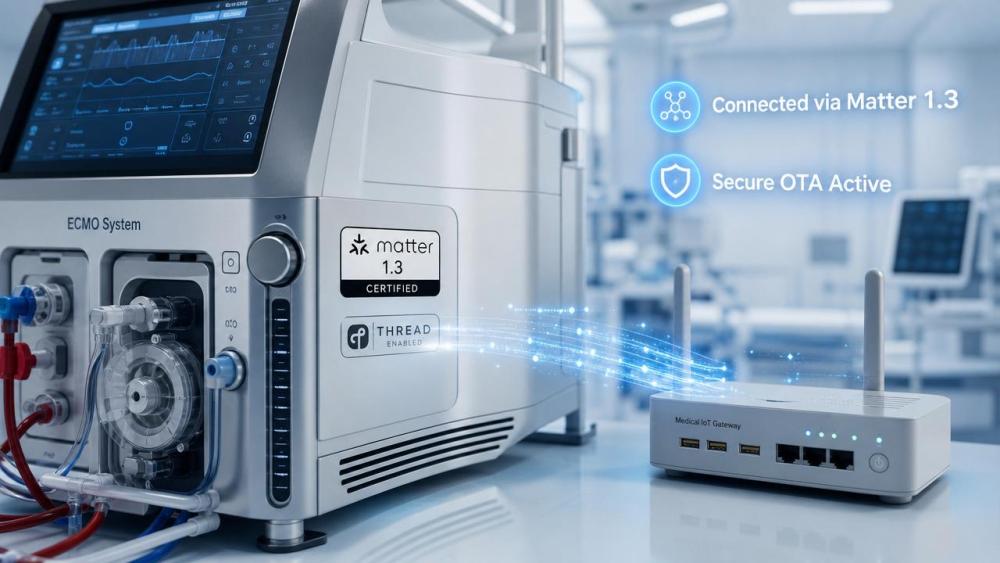
FDA’s Updated Cybersecurity Requirement for ECMO Devices
The FDA published ECMO Systems Cybersecurity Guidance Revision 3 on May 31, 2026. For the first time, the guidance explicitly incorporates the Matter 1.3 standard—a unified, open-source smart home interoperability protocol—into the cybersecurity and communication requirements for Class III life-supporting medical devices. The regulation applies prospectively: all new ECMO system submissions to the FDA after December 1, 2026 must demonstrate Matter 1.3 compliance to achieve clearance. No grandfathering or transitional allowances are specified for legacy architectures.
Impact Across the Medical Device Value Chain
Medical Device Exporters
Exporters targeting the U.S. market face revised premarket submission criteria. Matter 1.3 integration is now a mandatory functional and security validation point—not merely a compatibility suggestion. Submission dossiers must include test reports verifying secure device onboarding, attribute-level access control, and encrypted data exchange per Matter specifications.
Component Procurement Firms
Firms sourcing microcontrollers (MCUs), secure elements, or wireless SoCs must prioritize vendors whose offerings natively support Matter 1.3 over-the-air (OTA) updates, Thread networking stack certification, and PSA Certified Level 3 security. Legacy MCU families lacking TLS 1.3, secure boot, or hardware-based key storage may no longer meet baseline eligibility.
ECMO System Manufacturers
Manufacturers must redesign firmware architecture to embed the Matter SDK—including its device commissioning flow, cluster library, and OTA update service—within real-time operating environments constrained by IEC 62304 safety requirements. This introduces new verification challenges across functional safety (IEC 61508) and cybersecurity (IEC 81001-5-1) boundaries.
Regulatory & Compliance Service Providers
Third-party consultants and testing labs must expand their capabilities to cover Matter-specific conformance testing (e.g., CSA-certified test suites), threat modeling for Matter-enabled attack surfaces (e.g., unauthorized controller pairing), and alignment between FDA’s cybersecurity documentation templates and Matter’s certification artifacts.
Key Compliance Priorities for Manufacturers
Reassess MCU and Connectivity Hardware Roadmaps
Legacy designs relying on proprietary BLE or Wi-Fi stacks must be re-evaluated. Migration to Matter-ready silicon (e.g., Nordic nRF52840 + OpenThread, Silicon Labs EFR32MG24) requires hardware revision cycles, PCB layout changes, and RF coexistence validation—impacting time-to-market for 2026–2027 submissions.
Integrate Matter into Firmware Development Lifecycle
Matter 1.3 mandates deterministic OTA update rollback, zero-touch commissioning, and certificate-based identity binding. These features must be embedded early in the software development lifecycle—not added as post-validation patches—to satisfy FDA’s expectation of ‘cybersecurity by design’.
Align FDA Submission Documentation with Matter Requirements
De Novo or 510(k) submissions must now include: (1) a Matter architecture diagram mapping clusters to clinical functions; (2) traceability matrix linking Matter security controls to FDA’s Cybersecurity Validation Table; and (3) third-party test reports confirming CSA Matter Certification or equivalent conformance.
Industry Perspective: Beyond Interoperability, a New Security Baseline
Analysis shows this move signals a broader regulatory pivot: the FDA is treating standardized, vendor-neutral interoperability not as an optional enhancement—but as a foundational cybersecurity control. From an industry perspective, Matter 1.3 serves as both a technical specification and a de facto risk-mitigation framework. What deserves closer attention is the implied extension of supply chain accountability: component-level Matter compliance will increasingly influence OEM qualification decisions. Observably, manufacturers with established partnerships in the Connectivity Standards Alliance (CSA) ecosystem hold a tangible advantage in timeline predictability and test lab access.
Strategic Implications for Global Market Access
This requirement reinforces that U.S. market entry for critical care devices now hinges on dual compliance: meeting traditional safety standards (e.g., ISO 14971, IEC 62304) *and* demonstrating adherence to evolving digital infrastructure norms. It is more appropriate to understand this as a convergence of clinical engineering and platform-level software governance—not merely a protocol upgrade. While the immediate scope is limited to new ECMO registrations, precedent suggests similar Matter adoption may follow for ventilators, infusion pumps, and remote patient monitoring systems within 18–24 months.
Source Information and Verification Notes
This article was generated exclusively from the provided input: title, event date (2026-05-31), and event summary. Specific official source links were not provided in the input and should be verified continuously. Stakeholders are advised to monitor FDA’s official guidance portal, the Connectivity Standards Alliance’s Matter certification registry, and upcoming revisions to IEC 81001-5-1 for implementation clarifications, enforcement timelines, and stakeholder feedback summaries.
Recommended News
 Aug 31, 2026Clinical Imaging Innovation: Which Technologies Deliver Measurable Diagnostic Gains?Clinical imaging innovation delivers measurable diagnostic gains through photon-counting CT, AI reconstruction, and quantitative MRI—explore evidence-based selection insights.
 Aug 30, 2026How Surgical Navigation Technology Improves Accuracy in Complex Spine SurgerySurgical navigation technology spine surgery: discover how imaging, tracking, and workflow controls improve precision for complex procedures.
 Aug 29, 2026How to Select a Hematology Analyzer With Reliable Reticulocyte CountingHematology analyzers retic selection guide: compare precision, flags, workflow, QC, and connectivity to achieve reliable reticulocyte counting.
 Aug 28, 2026Planning Operating Room Technology for a High-Throughput Surgery CenterOperating room technology for a surgery center: plan workflows, integration, uptime, and safety to boost throughput and create future-ready surgical rooms.
 Aug 27, 2026Building Medical Compliance Analytics for Middle East Market AccessMedical compliance analytics Middle East: build device-specific evidence maps, align local requirements, and accelerate market access with confidence.
 Aug 26, 2026How Surgical Equipment Digitalization Is Reshaping Hospital Investment in Latin AmericaSurgical equipment digitalization Latin America is reshaping hospital investment, from smart ORs to ROI-driven upgrades. Explore what buyers now value most.
 Aug 25, 2026How to Evaluate a Medical Compliance Intelligence Provider for Global Market AccessMedical compliance intelligence provider selection can make or break global market access. Learn how to assess technical depth, update quality, and commercial fit before choosing.
 Aug 24, 2026How Advanced Clinical Imaging Is Improving Cardiology Diagnosis and Treatment PlanningAdvanced clinical imaging cardiology is transforming diagnosis and treatment planning with clearer anatomy, tissue insight, and procedural guidance. Discover how it reduces uncertainty and supports smarter cardiac decisions.
 Aug 23, 2026How to Source Medical Devices in North America: Supplier Vetting and Market Access RisksMedical device sourcing North America made practical: learn how to vet suppliers, reduce compliance risks, and protect market access with smarter procurement decisions.
 Aug 22, 2026What Are Integrated Critical Care Systems and How Do Hospitals Evaluate Them?Critical care systems integrated: learn how hospitals assess ICU platforms for interoperability, alarm safety, workflow efficiency, and long-term value before buying.
 Aug 21, 2026How to Evaluate High-Resolution Diagnostic Imaging Systems for Detail-Critical ExamsDiagnostic imaging systems high resolution: learn how to compare detail-critical performance, workflow fit, dose efficiency, and ROI to choose the right system with confidence.
 Aug 20, 2026How to Evaluate Medical Equipment Performance Before Purchase?Medical equipment evaluation performance starts before purchase. Learn how to assess safety, workflow fit, compliance, uptime, and total cost to choose devices that truly perform.
 Aug 19, 2026How to Evaluate Small-Footprint Laboratory Diagnostic Equipment for Space-Limited LabsLaboratory diagnostic equipment small footprint choices require more than size checks. Learn how to assess workflow, throughput, compliance, and service access for smarter lab buying.
 Aug 18, 2026Biochemical Molecular Diagnostics Explained: Methods, Clinical Uses, and Lab Selection CriteriaBiochemical molecular diagnostics explained: compare key methods, clinical applications, and lab selection criteria to choose reliable, compliant testing with confidence.
 Aug 17, 2026How to Choose Diagnostic Equipment Solutions for a Clinic: Key Factors That Affect Workflow and CostDiagnostic equipment solutions clinic buyers can use to improve workflow, control total cost, and avoid hidden service risks. Learn the key factors before you invest.
 Aug 16, 2026How to Choose a Blood Cell Analyzer for a Small Lab: Throughput, CBC Menu, and CostBlood cell analyzers small lab buyers can compare throughput, CBC menu, and total operating cost with confidence. Learn how to avoid waste, reduce downtime, and choose the right fit.
 Aug 16, 2026FDA Approval of AMDS Hybrid Prosthesis Removes IRB Step for Faster U.S. AccessFDA approval of AMDS Hybrid Prosthesis removes the IRB step, speeding U.S. access for acute aortic dissection care and reshaping hospital procurement and supporting equipment demand.
 Aug 15, 2026What Hospital Technology Infrastructure Is Needed for Reliable Interoperability?Hospital technology infrastructure interoperability depends on secure networks, integration engines, identity services, and governance. Discover what hospitals need for reliable, scalable connectivity.
 Aug 14, 2026What to Look for in an Advanced Diagnostic Systems Distributor Before You BuyAdvanced diagnostic systems distributor: learn what to check before buying, from compliance and technical depth to delivery reliability and after-sales support. Make a smarter procurement decision today.
 Aug 14, 2026China Temporarily Bans Helium ExportsChina Temporarily Bans Helium Exports: learn how the July 10, 2026 rule may disrupt MRI, ECMO, and anesthesia device supply chains, compliance, and delivery planning for global buyers.
 Aug 13, 2026How CT Reconstruction Technology Impacts Image Quality, Dose, and WorkflowMedical imaging reconstruction technology CT shapes image quality, dose, and workflow. Learn how smarter CT reconstruction improves diagnostics and efficiency.
 Aug 13, 2026FDA clears AMDS PMA, easing U.S. hospital accessFDA clears AMDS PMA, easing U.S. hospital access for Artivion’s aortic arch device and speeding procurement, compliance, and deployment.
 Aug 12, 2026Hospital Diagnostic Equipment Comparison: What Buyers Should Evaluate Beyond PriceDiagnostic equipment comparison hospital buyers can trust: learn how to evaluate clinical performance, uptime, compliance, integration, and long-term ROI beyond price.
 Aug 12, 2026FDA Draft Guidance Reshapes AI Device ComplianceFDA Draft Guidance reshapes AI device compliance with new postmarket monitoring expectations for AI/ML-enabled SaMD. Learn what it means for U.S. market access, distributors, and exporters.















Related News
- 00
0000-00
Clinical Imaging Innovation: Which Technologies Deliver Measurable Diagnostic Gains? - 00
0000-00
How Surgical Navigation Technology Improves Accuracy in Complex Spine Surgery - 00
0000-00
How to Select a Hematology Analyzer With Reliable Reticulocyte Counting - 00
0000-00
Planning Operating Room Technology for a High-Throughput Surgery Center - 00
0000-00
Building Medical Compliance Analytics for Middle East Market Access
Weekly Insights
Stay ahead with our curated technology reports delivered every Monday.