
FDA Requires PCCP for AI Flexible Videoscopes
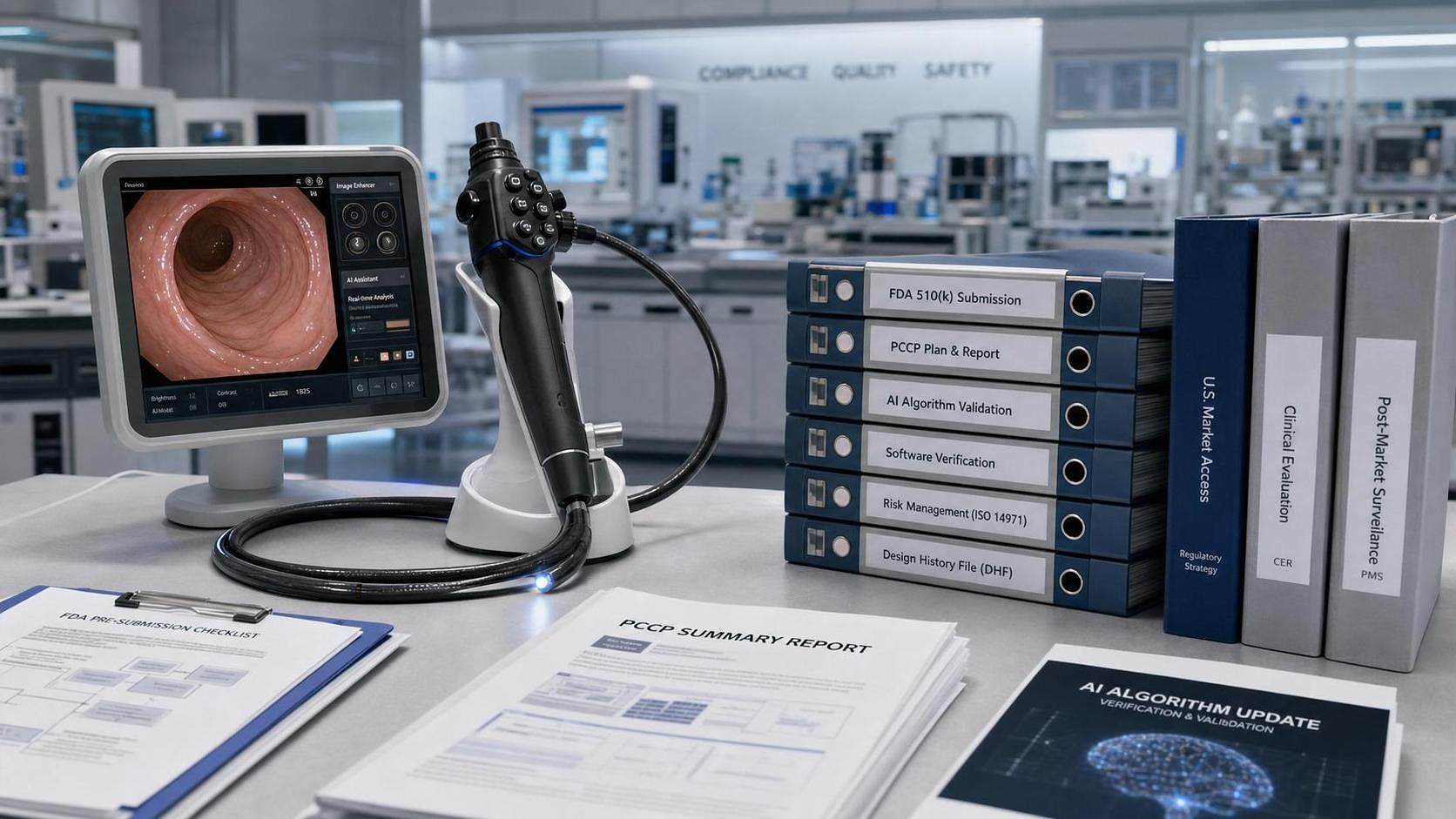




On June 22, 2026, the FDA updated its post-market guidance for AI/ML SaMD and made a new compliance requirement explicit for AI-enabled Flexible Videoscopes registered in the U.S.: a Predetermined Change Control Plan (PCCP) must be submitted as part of registration. Because the requirement becomes mandatory on October 1, 2026 and applies to both already cleared 510(k) products and new submissions, the change deserves attention not only from device manufacturers, but also from regulatory, procurement, supply, and delivery teams that depend on software update timing, technical documentation, and market access continuity.
What the FDA has now made explicit
The confirmed change is limited but operationally important. The FDA updated its AI/ML SaMD post-market regulatory guidance on June 22, 2026. Under that update, all Flexible Videoscopes with AI functions must submit a PCCP when registering in the U.S.
The requirement covers planned algorithm change pathways for functions including image enhancement, lesion marking, and real-time polyp classification. The mandatory enforcement date is October 1, 2026. The scope includes products that have already received 510(k) clearance as well as new product submissions.
Where the compliance impact is likely to appear first
For manufacturers planning U.S. registration
From an industry perspective, manufacturers are the first group directly affected because the rule change attaches a new documentation expectation to registration of AI-enabled Flexible Videoscopes. The practical impact is likely to fall on regulatory submission files, software change planning, and internal coordination between product, clinical, and quality teams. What deserves closer attention is whether existing technical files and update roadmaps are already structured in a way that can support a PCCP without delaying filing or follow-on changes.
For holders of already cleared products
Observably, the change matters not only to new entrants but also to companies with products that already hold 510(k) clearance. Because the summary states that the requirement affects previously cleared products, businesses with installed devices and ongoing algorithm iteration plans may need to review whether future image enhancement, lesion marking, or classification updates align with the new control-plan expectation. The immediate issue is not a confirmed market outcome, but a compliance review need tied to post-clearance change management.
For procurement, distribution, and delivery coordination
Analysis shows that downstream teams may also feel the effect even though the rule is directed at registration. Procurement groups, distributors, and delivery planners often rely on stable product documentation, update schedules, and acceptance criteria. If suppliers need to revise submission packages or adjust software release sequencing to fit a PCCP, buyers and channel partners may need to pay closer attention to document completeness, version control, and delivery timing for AI-enabled endoscopy systems intended for the U.S. market.
For compliance and service support functions
What deserves closer attention is the after-sales and support side of AI-enabled devices. Where algorithm functions are updated over time, service teams and compliance staff may need clearer internal records on what changes were planned, how those changes were described in registration materials, and how product versions are tracked across the field. The provided information does not define a final execution model, but it does indicate a higher documentation burden around software evolution.
What companies should review before the deadline
Check whether current change pathways are documented clearly
Analysis shows that companies should first compare their existing algorithm update plans against the newly explicit PCCP expectation. This is especially relevant for planned changes involving image enhancement, lesion marking, and real-time polyp classification, because those functions are specifically named in the summary.
Review submission files and supporting technical materials
Businesses preparing U.S. registrations may need to examine whether regulatory files, software descriptions, technical documents, and related supporting materials are organized to show a defined change path rather than only a current algorithm state. The input does not provide detailed documentation standards, so this remains an area for continued monitoring rather than a settled checklist.
Revisit procurement and launch timelines
For companies managing product launch, supply, or customer delivery schedules, it is reasonable to review whether the October 1, 2026 enforcement date could affect filing timing, update releases, or contract execution for AI-enabled Flexible Videoscopes in the U.S. market. This should be treated as a planning signal, not as proof of a specific delay outcome.
Watch for further execution language and market response
Observably, the headline requirement is already clear, but the practical interpretation may still depend on later official wording, review practice, procurement language, or customer documentation requests. Companies should therefore watch for changes in compliance language, tender documents, customer qualification requests, and internal approval standards tied to AI software modifications.
How this change is best understood at this stage
From an industry perspective, this is more appropriate to understand as a concrete execution signal rather than a broad policy discussion. The reason is that the requirement has a defined enforcement date and applies to both existing 510(k)-cleared products and new submissions. At the same time, analysis shows that the market still needs to observe how consistently the PCCP expectation is translated into registration review practice, customer requirements, and product update management. In other words, the rule direction is clear, while some operational details still warrant close follow-up.
A practical reading of the development
The main significance of this update is that algorithm iteration for AI-enabled Flexible Videoscopes is no longer just a product design issue; it is now more clearly tied to registration readiness and ongoing compliance planning in the U.S. market. A neutral reading is that companies should treat the change as an implemented regulatory requirement with immediate preparation value, while remaining cautious about assuming uniform downstream effects before more execution-level feedback appears.
Basis of this article and what still needs verification
This article is generated from the user-provided news title, event date, and event summary. For developments of this type, relevant source categories often include official announcements, releases from regulatory authorities, trade or customs authorities, industry association updates, standards organization documents, and reporting by established professional media.
A specific official source link was not provided in the input, so the exact original publication path still needs to be verified on an ongoing basis. Observably, the next points worth tracking are any further policy detail, certification or review interpretation, changes in tender or procurement documentation, industry feedback, and how affected companies implement the requirement in practice.
Recommended News
 Sep 22, 2026How Life Science Labs Can Select Biomedical Research Equipment by Workflow and ThroughputBiomedical research equipment life science labs can select with confidence by aligning workflow, throughput, automation, data integrity, and scalable support.
 Sep 21, 2026How to Plan LIS Connectivity for Chemiluminescence Analyzers Without Data GapsChemiluminescence analyzers LIS connectivity: learn how to prevent data gaps with field mapping, exception workflows, end-to-end validation, and reliable go-live planning.
 Sep 20, 2026Selecting Fluorescence PCR Instruments: Detection Channels, Sensitivity, and Workflow FitPCR diagnostic instruments fluorescence detection guide: compare channels, sensitivity, multiplexing, and workflow fit to select a reliable platform.
 Sep 19, 2026Biomedical Signal Processing: From Sensor Data to Clinical Decision SupportBiomedical signal processing transforms sensor data into reliable clinical decision support. Explore AI, imaging, IVD, ICU monitoring, and compliance-ready MedTech insights.
 Sep 18, 2026How to Evaluate a Diagnostic Imaging Platform for Multi-Modality Workflow IntegrationDiagnostic imaging platform evaluation guide: assess multi-modality workflows, interoperability, AI integration, image integrity, security, and scalability for safer clinical decisions.
 Sep 17, 2026ISO 13485 for Medical Imaging Equipment: What Manufacturers Must DocumentMedical imaging equipment ISO 13485: discover essential documentation for design controls, risk management, traceability, software, and post-market quality.
 Sep 16, 2026Robotic MIS Equipment: What Hospitals Should Evaluate Before AdoptionMinimally invasive surgical equipment robotic adoption guide: evaluate workflow, safety, imaging, costs, cybersecurity, and service readiness.
 Sep 15, 2026How to Evaluate Biomedical Signal Processing Suppliers for Clinical Device ProjectsBiomedical signal processing supplier evaluation guide for clinical device teams—compare signal fidelity, regulatory evidence, cybersecurity, integration, and lifecycle support.
 Sep 14, 2026How Integrated Clinical Diagnostics Solutions Reduce Turnaround Time Across Lab WorkflowsIntegrated clinical diagnostics solutions reduce lab turnaround time by connecting workflows, automation, and data. Discover practical strategies for faster, traceable results.
 Sep 13, 2026ECMO System Market Outlook: Demand Drivers, Investment Risks, and Growth OpportunitiesECMO system market outlook explores demand drivers, investment risks, regulatory factors, and growth opportunities shaping critical-care innovation and adoption.
 Sep 12, 2026Where to Find Reliable Medical Device Information for Research and Due DiligenceMedical device information resource guide for due diligence: verify regulatory, clinical, safety, and technical evidence to make confident decisions.
 Sep 11, 2026Medical Equipment Intelligence: A Resource for Comparing Clinical TechnologiesMedical equipment intelligence resource for comparing clinical technologies by clinical fit, compliance, workflow, and total cost—make confident, evidence-led decisions.
 Sep 10, 2026How to Integrate Application-Specific Medical Solutions Into Existing Clinical WorkflowsApplication-specific medical solutions integration: learn how to align clinical workflows, interoperability, safety, and measurable outcomes for reliable deployment.
 Sep 09, 2026Medical Supplier Evaluation Checklist: How to Verify Quality, Compliance, and Delivery RiskMedical supplier evaluation checklist for verifying quality, compliance, service capacity, configuration accuracy, and delivery risk before purchase approval.
 Sep 08, 2026Selecting IVD Instruments With Automatic Sample Loading: Key Workflow CriteriaIVD instruments automatic sample loading: evaluate workflow capacity, traceability, STAT handling, LIS integration, and exceptions for smarter lab selection.
 Sep 07, 2026How to Evaluate a Clinical Diagnostic Systems Supplier for Hospital ProcurementClinical diagnostic systems supplier evaluation guide for hospitals: compare clinical performance, compliance, uptime, interoperability, cybersecurity, and lifecycle value.
 Sep 07, 2026How to Choose Critical Care Equipment for Emergency Room ReadinessCritical care equipment emergency room planning: discover how to select reliable, interoperable devices that strengthen readiness, safety, and lifecycle value.
 Sep 05, 2026Ventilator Comparison for ICU and Transport Use: Which Features Matter Most?Ventilator comparison for ICU and transport use: discover the features that support safer ventilation, reliable monitoring, battery planning, and seamless patient transfers.
 Sep 14, 2026Is Photon-Counting CT Clinically Better Than Conventional CT for Exporters?Is photon-counting CT clinically better than conventional CT for exporters? Explore clinical use cases, compliance, ROI, and market-ready sales strategy.
 Sep 14, 2026Do You Need a Local Distributor to Register Medical Devices in Southeast Asia?Do I need a local distributor to register devices in Southeast Asia? Learn how to separate regulatory ownership, import rights, and distribution for smoother market access.
 Sep 13, 2026How Should an MDR Clinical Performance Study Be Designed for IVD Products?How to design a clinical performance study for IVD products MDR: explore claim-driven endpoints, representative specimens, bias control, and audit-ready evidence.
 Sep 13, 2026What Validation Is Required for Medical Imaging Algorithms Under the MDR?What validation is required for medical imaging analysis algorithms MDR? Explore technical, clinical, risk, dataset, and post-market evidence requirements.
 Sep 12, 2026How Are AI Imaging False Positives Handled in Regulatory Review?How are AI imaging false positives handled under regulatory review? Explore FDA and EU MDR expectations for risk control, clinical validation, labeling, and post-market monitoring.
 Sep 12, 2026What After-Sales Technical Support Is Expected for Life-Support Exports?What after-sales technical support is expected for life support exports? Explore essential service, training, spare-parts, cybersecurity, and compliance requirements.



















Related News
- 00
0000-00
EU MDR Transition Ends, Endoscope Re-Certification Becomes Urgent - 00
0000-00
EU MDR Annex XVI Now Requires Separate CE for Accessories - 00
0000-00
EU MDR Transition Ends for Endoscopy Device Imports - 00
0000-00
EU MDR Rule Triggers CER Updates for Endoscopy Devices - 00
0000-00
EU MDR Update Sets 12-Month CER Rule for Ultrasound and Endoscopy
Weekly Insights
Stay ahead with our curated technology reports delivered every Monday.