
FDA Tightens IVD Export Data Requirements
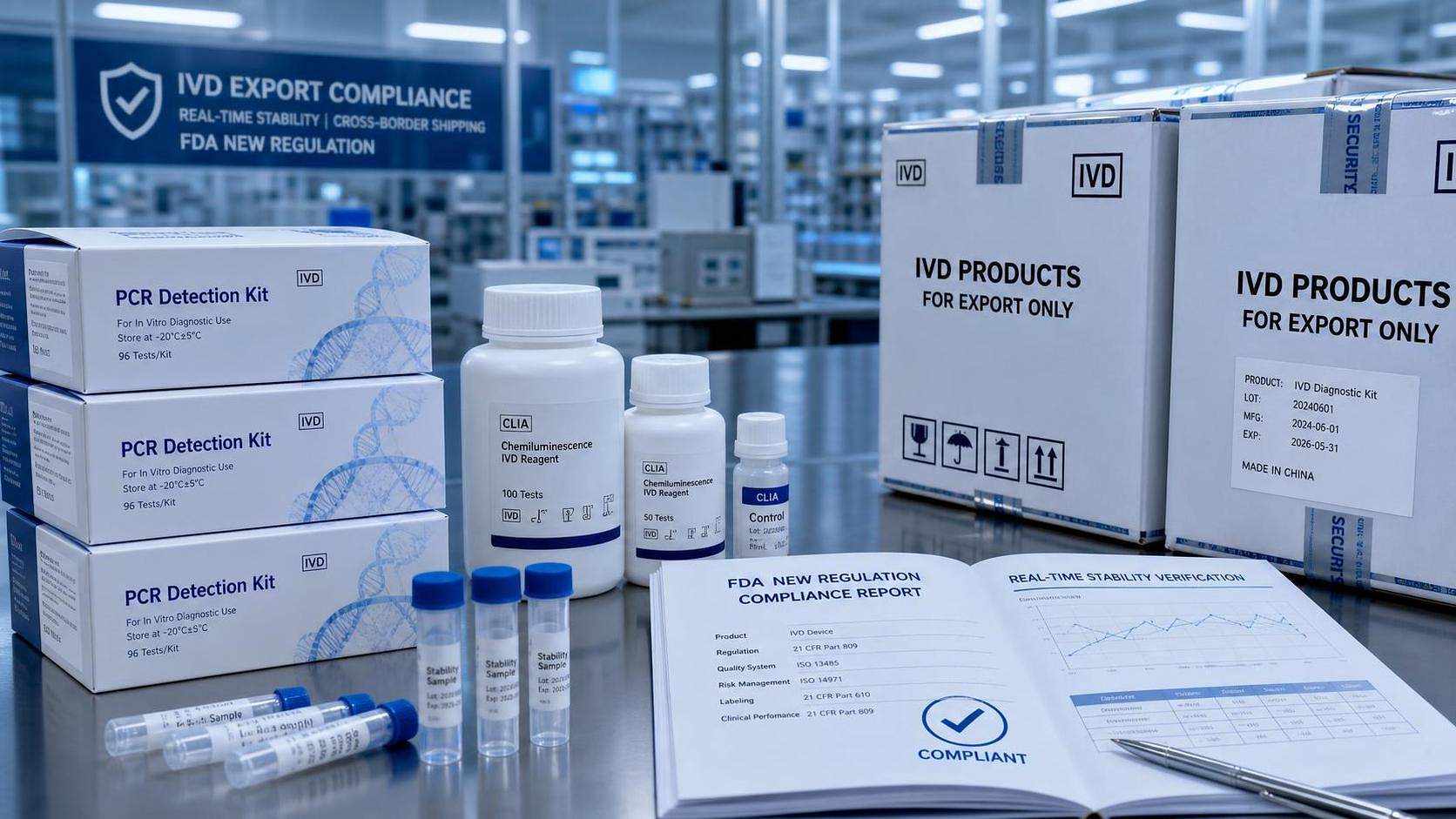




On July 24, 2026, the FDA introduced a new compliance signal for IVD exports to the United States: from October 1, 2026, molecular diagnostics (PCR) and chemiluminescence IVD reagents shipped into the U.S. must be accompanied by real-time stability study reports verified under ISO 17511, rather than accelerated aging data alone. For manufacturers, exporters, registration teams, and supply chain partners serving the U.S. market, this is worth close attention because it directly affects entry compliance, document readiness, and the timing of market access.
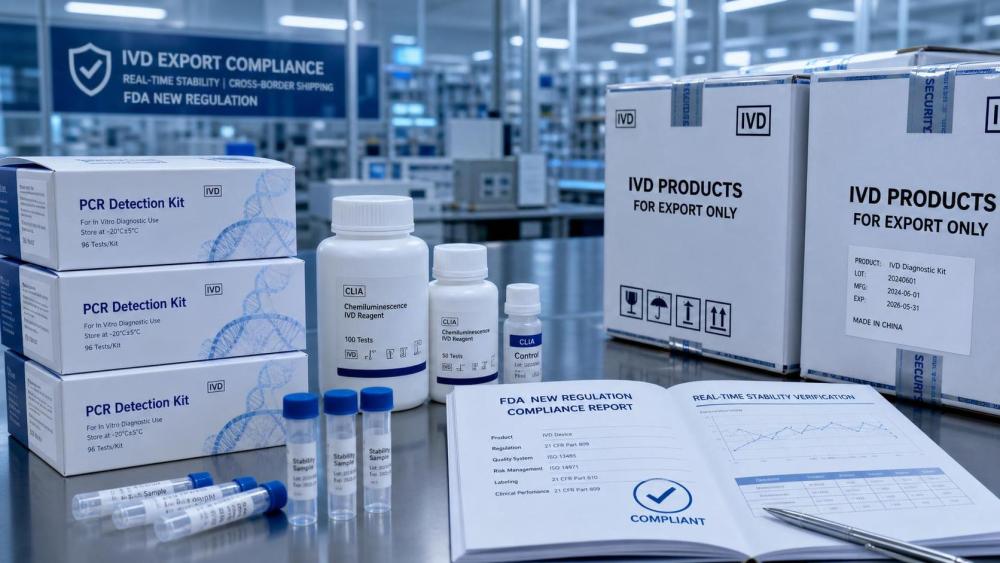
What the new FDA alert explicitly requires
According to the provided event summary, the FDA issued IVD Export Compliance Alert No. 26-07 on July 24, 2026. The alert states that, beginning October 1, 2026, all molecular diagnostic (PCR) and chemiluminescence in vitro diagnostic reagents exported to the United States must include real-time stability study reports verified under ISO 17511.
The summary also makes clear that accelerated aging data will not satisfy this requirement on its own. If the required documentation is not provided, the products may be refused entry into the United States or face suspension of the validity of an existing 510(k) clearance. The stated impact is direct for Chinese IVD manufacturers because the requirement affects export access pathways and registration timelines for the U.S. market.
Where the pressure is likely to appear across the business chain
Export-facing manufacturers may face document and timing pressure
From an industry perspective, manufacturers supplying PCR and chemiluminescence reagents to the U.S. are the first group likely to feel the change. The immediate issue is not only product performance, but whether the export file includes the specific form of stability evidence now required. This can affect release planning, registration sequencing, and shipment readiness where real-time stability documentation is incomplete or not aligned with the new requirement.
Regulatory and certification teams will need to reassess submission packages
For regulatory affairs and compliance functions, the change centers on technical documentation. What deserves closer attention is whether existing files, internal validation records, and supporting compliance materials are structured around real-time stability data verified under ISO 17511. Where dossiers or trade documents have been built around accelerated aging evidence, the gap may shift from a scientific issue to a market access issue.
Distributors, import channels, and procurement counterparts may see delivery uncertainty
Channel partners and procurement-side participants may also be affected because entry refusal or questions over 510(k) validity can translate into disruption at the delivery stage. Observably, buyers and downstream distributors may need to review whether suppliers can provide the required reports before shipment, especially for products already scheduled for export close to the October 1, 2026 effective date.
Testing and supply chain service providers may be pulled into compliance preparation
Service providers involved in testing support, documentation review, logistics coordination, or quality traceability may see increased demand for readiness checks. Analysis shows that the operational focus is likely to move toward report completeness, document consistency, and shipment-level compliance review, rather than standard commercial processing alone.
Practical points companies should watch now
Check whether current stability evidence matches the new threshold
Companies shipping affected IVD products to the United States should review whether their current stability data packages are based on real-time studies and whether those studies are verified under ISO 17511 as required in the summary. Where the available evidence is limited to accelerated aging data, the issue should be treated as a potential compliance gap rather than a routine documentation matter.
Review trade documents and registration materials together
The summary links the requirement both to border entry and to 510(k) validity. That means export documentation, technical files, and registration materials should be checked together. Analysis shows that separating customs-facing paperwork from regulatory-facing evidence may create avoidable risk if the same stability issue can affect both shipment clearance and the standing of an existing authorization.
Revisit delivery schedules and procurement commitments
For contracts, shipment plans, and procurement arrangements tied to the U.S. market, companies should closely watch whether the new documentation requirement changes delivery timing. This is especially relevant where production lots are already planned but the supporting real-time stability reports are still being completed or reviewed. The available information does not provide detailed enforcement procedures, so firms should treat scheduling risk as something to monitor carefully rather than as a settled outcome.
Track follow-on language and market execution signals
The provided information confirms the requirement and its effective date, but it does not describe detailed implementation procedures, document format expectations, or any transitional handling beyond the stated deadline. For that reason, companies should continue monitoring official wording, practical review standards, buyer-side documentation requests, and any changes in tender or supplier qualification materials connected to U.S.-bound business.
Why this looks more like an execution signal than a background policy update
Analysis shows that this development is better understood as an operational compliance signal tied to market access, rather than a broad policy statement with distant effect. The combination of a fixed effective date, a defined documentation requirement, and stated consequences at the import and 510(k) level suggests that affected companies should read it as a rule with immediate workflow implications.
At the same time, it is also more appropriate to understand this as a change whose execution details still require observation. The summary confirms the threshold and the consequences, but it does not settle how consistently the requirement will be reviewed in practice across different product files, shipment scenarios, or follow-on regulatory interactions. That is why industry attention should remain on implementation signals as much as on the headline requirement itself.
How to read the change at this stage
For the IVD sector, this update matters because it shifts the compliance focus from having stability support in general to having the specific type of stability evidence now required for U.S. export of affected products. The practical significance lies in export admissibility, registration timing, and document readiness across manufacturing, regulatory, and delivery functions.
A balanced reading is that this is already a concrete rule change with a defined effective date, while its full execution path still needs to be watched through official clarifications and market practice. For companies exposed to the U.S. market, the most reasonable approach now is to treat real-time stability documentation as a near-term compliance checkpoint rather than a later-stage administrative detail.
Basis of this article and what still needs verification
This article is generated from the user-provided news title, event date, and event summary. For events of this kind, commonly relevant source categories may include official regulatory announcements, releases from supervisory authorities, customs or trade administration information, industry association notices, standard-setting documents, and reporting by established professional media.
No specific official source link was provided in the input, so the exact official publication path still requires follow-up verification. Observably, the points that still merit continued monitoring include detailed implementation language, certification and review interpretations, changes in tender or procurement documentation, market feedback from affected participants, and how companies execute compliance adjustments before and after October 1, 2026.
Recommended News
 Sep 07, 2026How to Evaluate a Clinical Diagnostic Systems Supplier for Hospital ProcurementClinical diagnostic systems supplier evaluation guide for hospitals: compare clinical performance, compliance, uptime, interoperability, cybersecurity, and lifecycle value.
 Sep 07, 2026How to Choose Critical Care Equipment for Emergency Room ReadinessCritical care equipment emergency room planning: discover how to select reliable, interoperable devices that strengthen readiness, safety, and lifecycle value.
 Sep 05, 2026Ventilator Comparison for ICU and Transport Use: Which Features Matter Most?Ventilator comparison for ICU and transport use: discover the features that support safer ventilation, reliable monitoring, battery planning, and seamless patient transfers.
 Sep 08, 2026ICU Ventilator Comparison: Which Features Matter for Patient Acuity Levels?Ventilator comparison for ICUs: discover which ventilation modes, alarms, monitoring, and workflow features best match patient acuity and improve critical-care decisions.
 Sep 08, 2026Critical Care Equipment Market Trends: Which Segments Are Growing Fastest?Critical care equipment market trends reveal fast growth in connected monitoring, advanced ventilation, ECMO, and integrated service solutions. Explore the segments shaping smarter ICUs.
 Sep 07, 2026What Defines Life-Critical Medical Technology in High-Risk Care Settings?Life-critical medical technology: discover how dependable diagnostics, life support, workflows, and readiness protect patients when every second counts.
 Sep 07, 2026Powered Operating Tables Market: What Is Driving Hospital Procurement?Powered operating tables market insights: discover what drives hospital procurement, from imaging compatibility and workflow efficiency to lifecycle value and surgical flexibility.
 Sep 06, 2026How to Calculate the Total Cost of Ownership for Medical DevicesTotal cost of ownership medical devices: learn to calculate lifecycle costs, downtime, service, compliance, and ROI for smarter hospital investments.
 Sep 06, 2026How to Verify Energy Output Accuracy in Medical Equipment Before Clinical UseVerification of energy output accuracy in medical equipment: learn practical, risk-based steps to confirm safe, compliant performance before clinical use.
 Sep 05, 2026Engineering Solutions for Medical Devices: From Prototype to Clinical DeploymentEngineering solutions for medical devices—from prototypes to clinical deployment. Learn how to align risk, evidence, usability, compliance, and manufacturing for market-ready innovation.
 Sep 05, 2026Medical Device Interfacing: How to Connect Legacy Equipment Without Data LossMedical device interfacing for legacy equipment: preserve patient data, clinical context, audit trails, and reliability with secure, loss-free integration strategies.
 Sep 04, 2026Lead Glass Applications in Imaging Rooms: A Practical Buyer GuideAn application guide for lead glass in medical imaging rooms, covering viewing windows, shielding coordination, optical quality, packing, and acceptance checks.
 Sep 03, 2026How European Hospitals Assess Application-Specific Medical Solutions for Clinical FitApplication-specific medical solutions Europe: discover how hospitals assess clinical fit, workflow integration, compliance, value, and long-term resilience.
 Sep 02, 2026How Precision Diagnostics Technology Is Reshaping Pathology WorkflowsPrecision diagnostics technology pathology is transforming workflows through digital slides, AI, molecular testing, and interoperable data—see what drives reliable implementation.
 Sep 01, 2026What to Evaluate in AI Image Reconstruction Software for Clinical Imaging?AI image reconstruction software: learn how to evaluate diagnostic fidelity, workflow integration, safety, and change control for confident clinical imaging decisions.
 Aug 31, 2026Clinical Imaging Innovation: Which Technologies Deliver Measurable Diagnostic Gains?Clinical imaging innovation delivers measurable diagnostic gains through photon-counting CT, AI reconstruction, and quantitative MRI—explore evidence-based selection insights.
 Aug 30, 2026How Surgical Navigation Technology Improves Accuracy in Complex Spine SurgerySurgical navigation technology spine surgery: discover how imaging, tracking, and workflow controls improve precision for complex procedures.
 Aug 29, 2026How to Select a Hematology Analyzer With Reliable Reticulocyte CountingHematology analyzers retic selection guide: compare precision, flags, workflow, QC, and connectivity to achieve reliable reticulocyte counting.
 Aug 28, 2026Planning Operating Room Technology for a High-Throughput Surgery CenterOperating room technology for a surgery center: plan workflows, integration, uptime, and safety to boost throughput and create future-ready surgical rooms.
 Aug 27, 2026Building Medical Compliance Analytics for Middle East Market AccessMedical compliance analytics Middle East: build device-specific evidence maps, align local requirements, and accelerate market access with confidence.
 Aug 26, 2026How Surgical Equipment Digitalization Is Reshaping Hospital Investment in Latin AmericaSurgical equipment digitalization Latin America is reshaping hospital investment, from smart ORs to ROI-driven upgrades. Explore what buyers now value most.
 Aug 25, 2026How to Evaluate a Medical Compliance Intelligence Provider for Global Market AccessMedical compliance intelligence provider selection can make or break global market access. Learn how to assess technical depth, update quality, and commercial fit before choosing.
 Aug 24, 2026How Advanced Clinical Imaging Is Improving Cardiology Diagnosis and Treatment PlanningAdvanced clinical imaging cardiology is transforming diagnosis and treatment planning with clearer anatomy, tissue insight, and procedural guidance. Discover how it reduces uncertainty and supports smarter cardiac decisions.
 Aug 23, 2026How to Source Medical Devices in North America: Supplier Vetting and Market Access RisksMedical device sourcing North America made practical: learn how to vet suppliers, reduce compliance risks, and protect market access with smarter procurement decisions.






















Related News
- 00
0000-00
How Precision Diagnostics Technology Is Reshaping Pathology Workflows - 00
0000-00
Biochemical Molecular Diagnostics Explained: Methods, Clinical Uses, and Lab Selection Criteria - 00
0000-00
What to Look for in an Advanced Diagnostic Systems Distributor Before You Buy - 00
0000-00
FDA Tightens AI Validation Rules for IVD Devices - 00
0000-00
FDA Tightens Clinical Evidence Bar for PCR and NGS IVDs
Weekly Insights
Stay ahead with our curated technology reports delivered every Monday.